
In This Article
Somewhere between your third failed acne face wash and your fourth trip to the skincare aisle, a plain, unglamorous bar of soap starts to look kind of tempting. No pump, no plastic bottle leaching into a landfill, no mystery gel — just a chunk of something that promises to actually do something about the blackheads camped out on your nose. That’s the appeal of salicylic acid bar soap for acne: it’s old-school, it’s cheap, and unlike a lot of trendy skincare, the science behind it isn’t hype. Salicylic acid is a beta hydroxy acid (BHA) that’s oil-soluble, meaning it can slip down into a clogged pore and dissolve the gunk from the inside rather than just scrubbing the surface. That’s a meaningfully different mechanism than a physical scrub, and it’s why dermatologists still reach for it decades after it was first bottled.
In this guide, we tested the research (not our own faces — more on that honesty policy in a second) on seven real, currently sold bars that range from a $7 drugstore basic to a $20-plus dermatologist-developed formula. We’ll break down what each one actually does, who it’s genuinely good for, and where it falls short, because “unclogs pores” is doing a lot of heavy lifting in most product descriptions and somebody needs to unpack it. You’ll also get comparison tables, a routine you can lift straight from acne.org-style minimalist regimens, and answers to the questions people actually type into Google at 1 a.m. while picking at their chin.
Quick Comparison Table: Salicylic Acid Bar Soap for Acne at a Glance
Before diving into the full breakdown, here’s the short version. Salicylic acid concentration in over-the-counter bars typically sits between 0.5% and 2%, which is enough for daily maintenance without tipping into peel territory.
| Product | Active Ingredient(s) | Best For | Price Range |
|---|---|---|---|
| DermaHarmony 2% Salicylic Acid Bar Soap | 2% salicylic acid | Budget daily maintenance | $7-$10/bar |
| Asepxia Scrub Deep Cleansing Bar Soap | 2% salicylic acid + jojoba microbeads | Budget, physical + chemical combo | $4-$6/bar |
| CeraVe SA Cleansing Bar | Salicylic acid + ceramides + hyaluronic acid | Sensitive, barrier-compromised skin | $8-$11/bar |
| Derma-E Purifying Bar | Salicylic acid + activated charcoal + shea butter | Combination/oily skin needing hydration | $7-$9/bar |
| La Rosée Activated Charcoal Bar | Activated charcoal + tea tree + BHA-adjacent botanicals | Deep pore-clearing, oily skin | $10-$14/bar |
| DermaHarmony 10% Sulfur & 3% Salicylic Acid Bar | Sulfur + salicylic acid | Stubborn or hormonal breakouts | $14-$20/2-3 bars |
| Clinique Acne Solutions Cleansing Bar | Encapsulated salicylic acid | Premium, face-and-body, sensitive skin | $20-$26/bar |
Looking at this lineup, there’s a clear split between single-active bars built for gentle daily use and the sulfur-salicylic combo built for skin that’s stopped responding to the basics. The CeraVe SA Cleansing Bar and Derma-E Purifying Bar occupy a sensible middle ground for anyone who’s been burned by drying acne washes before, while the Asepxia Scrub Deep Cleansing Bar Soap is the one to grab if your only goal is spending under $5 and seeing if BHA soap does anything at all. Price naturally rises with formulation complexity — added ceramides, charcoal, or encapsulation tech all cost the brand more to source, and that shows up at checkout.
💬 Found a match already? Save this comparison and come back before you check out — the deeper breakdown below might change your pick.
Top 7 Salicylic Acid Bar Soaps for Acne: Expert Analysis
Coverage below spans budget, mid-range, and premium bars, plus a stronger sulfur-salicylic hybrid for people who’ve outgrown the gentle stuff. A note on integrity: none of the “aggregated reviewer sentiment” below is invented — it reflects patterns that show up repeatedly across verified purchase reviews on retail listings, and where independent testing data wasn’t verifiable, we say so rather than making it up.
1. DermaHarmony 2% Salicylic Acid Bar Soap — the fragrance-free budget baseline
This is about as close to a “control group” bar as salicylic acid soap gets: 2% salicylic acid, no added fragrance, no sulfur smell to mask. That simplicity is the whole pitch. At 2% concentration, it sits at the upper end of what’s typically found in daily-use OTC products, which means it’s strong enough to matter but formulated to be used every day without a break-in schedule most people can’t stick to.
The bar’s inactive ingredient list leans on saponified palm and coconut oils plus glycerin, so it’s a true soap rather than a syndet (synthetic detergent) bar — worth noting since true soaps run more alkaline and can feel tighter on skin than a pH-balanced cleanser. Reviewers consistently report that it lathers well for a medicated bar and that the scent, when sulfur-free, disappears within a minute of rinsing. It’s aimed squarely at people managing mild to moderate blackheads and general oiliness rather than anyone dealing with cystic or hormonal acne.
Aggregated feedback across retail listings repeatedly mentions two things: it works well on body acne (back, chest, shoulders) where a stronger, less delicate formula is welcome, and a subset of users note it can feel drying if used twice daily without a moisturizer chaser. That tracks with what’s known about salicylic acid generally — it’s a keratolytic, so it sheds surface skin cells, and skipping moisturizer afterward is the single most common way people sabotage an otherwise fine product.
Pros:
- ✅ Simple 2% formula with no added fragrance or dye
- ✅ Works on both facial and body acne areas
- ✅ Long-lasting bar for the price point
Cons:
- ❌ True-soap base can feel tight without a moisturizer
- ❌ No added barrier-support ingredients like ceramides
In the $7-$10 range depending on pack size, it’s a fair value pick if you want to test whether salicylic acid soap does anything for your skin before spending more.
2. Asepxia Scrub Deep Cleansing Bar Soap — the exfoliating multitasker on a budget
Asepxia leans into the “scrub” part of its name by combining 2% salicylic acid with actual jojoba microspheres, giving you chemical and mechanical exfoliation in the same bar. That’s a meaningfully different approach from a pure chemical bar — the beads provide immediate tactile feedback (you can feel it working) while the BHA does the slower job of dissolving what’s actually inside the pore.
Because it’s a legacy Latin American drugstore brand that’s been reformulated for U.S. distribution, it’s also sold in multi-bar value packs, which drives the per-bar cost down meaningfully compared to boutique options. The trade-off with any bead-based scrub is texture: jojoba beads are softer than walnut-shell scrubs of decades past, but “gentle exfoliating beads” and “gentle for your specific skin” aren’t always the same claim.
Real customer reviews on retail sites frequently mention fast results on body acne and blackheads within roughly a week of daily use, alongside a recurring note that the scent — while not overpowering — is more noticeable than fragrance-free competitors. A common complaint in user reviews is that the exfoliating texture can feel like too much for very reactive or eczema-prone skin, so it’s better suited to normal-to-oily skin that can tolerate a bit of mechanical action.
Pros:
- ✅ Combines chemical (BHA) and physical exfoliation
- ✅ Sold in value multi-packs for lower per-bar cost
- ✅ Popular for treating chest and back breakouts
Cons:
- ❌ Scent is more noticeable than unscented alternatives
- ❌ Beads may be too abrasive for reactive or eczema-prone skin
At around $4-$6 per bar (less in multi-packs), this is the entry point for anyone who wants texture and a BHA in one purchase.
3. CeraVe SA Cleansing Bar — the dermatologist-favorite for sensitive, barrier-weak skin
CeraVe built its entire reputation on ceramides, and its SA (salicylic acid) Cleansing Bar is the bar-soap extension of that formula philosophy: salicylic acid for exfoliation, paired with three essential ceramides and hyaluronic acid to keep the skin barrier intact while it works. What most buyers overlook about this model is that acne-prone skin doesn’t automatically mean oily-only skin — a lot of people dealing with breakouts also have a compromised moisture barrier, and stripping that further with a harsh cleanser tends to backfire into more oil production, not less.
Pharmacist-reviewed sources note that dermatologists frequently recommend ceramide-containing salicylic acid products specifically because acne-prone skin has been shown to have lower natural ceramide levels than average, which is a detail most acne soap marketing skips entirely. Spherical jojoba beads add a light physical exfoliation layer on top of the BHA, giving it a dual-action profile similar to Asepxia but with a noticeably more skin-barrier-conscious formula around it.
Reviewer sentiment aggregated from retail listings consistently praises this bar for use on rough, bumpy skin (including keratosis pilaris on the body, not just facial acne) and for not leaving the tight, stripped feeling that pure soap-based bars can cause. The main gripe that surfaces repeatedly is availability — this is a genuinely popular SKU that goes out of stock at various retailers more often than its liquid-cleanser siblings.
Pros:
- ✅ Ceramides and hyaluronic acid support the skin barrier
- ✅ Gentle enough for daily use on sensitive, reactive skin
- ✅ Doubles as a body exfoliant for rough or bumpy skin
Cons:
- ❌ Frequently out of stock at major retailers
- ❌ Milder acne-fighting strength than higher-concentration options
Priced around $8-$11 per bar, it’s the pick for anyone whose acne coexists with dryness or sensitivity rather than pure oiliness.
4. Derma-E Purifying Bar — the oil-balancing option with charcoal and shea butter
Derma-E’s Purifying Bar takes a different balancing act: salicylic acid to exfoliate and control breakouts, activated charcoal to draw out surface oil and impurities, and shea butter to offset the drying tendency that charcoal-and-BHA combinations can have. On paper, this is a smart pairing — charcoal alone can feel gimmicky since its pore-clearing claims are more about surface absorption than the deeper unclogging salicylic acid provides, but combined, you get both mechanisms working at once.
Based on the spec comparison with other combination-skin bars, Derma-E’s use of shea butter as a counterbalance is the standout detail. Most charcoal-and-BHA bars skip the moisturizing component entirely, betting that customers will layer a separate moisturizer on top — which is fine in theory, but plenty of people using an “all-in-one” bar are specifically trying to simplify their routine, not add steps back in.
Aggregated review themes point to this being well-liked by people with combination skin who get oily in the T-zone but dry on the cheeks, a skin type that a lot of acne-specific products handle poorly by treating the whole face as uniformly oily. The recurring critique is that the charcoal tint can leave a faint gray residue in white washcloths, which is cosmetic rather than a performance issue but worth knowing before laundry day.
Pros:
- ✅ Shea butter offsets the drying effect of charcoal and BHA
- ✅ Well-suited to combination skin types
- ✅ Cruelty-free formulation from an established clean-beauty brand
Cons:
- ❌ Charcoal can leave temporary residue on light-colored towels
- ❌ Lower salicylic acid concentration than dedicated acne bars
At roughly $7-$9 per bar, it’s a solid mid-range pick for combination skin that doesn’t want a one-note oil-stripping formula.
5. La Rosée Activated Charcoal Bar — the deep-cleansing option for genuinely oily skin
Where Derma-E hedges with shea butter, La Rosée Activated Charcoal Bar leans all the way into deep pore-clearing, pairing activated charcoal with tea tree oil and aloe for an oil-focused formula that skews closer to a detox bar than a gentle daily wash. Tea tree oil brings its own antibacterial properties into the mix, which is a genuinely useful addition for anyone dealing with the inflammatory, pustule-heavy side of acne rather than just blackheads.
Here’s what the spec sheet won’t tell you, but reviewers note: tea tree oil is a known sensitizer for a meaningful minority of users, so a bar built around it is a better fit for oily, resilient skin than for anyone with a documented tea tree allergy or a history of contact dermatitis. On paper, this makes La Rosée a more aggressive, “get in there” formula compared to the CeraVe bar’s barrier-first approach — neither is objectively better, they’re built for different skin.
Real-world reviewer sentiment aggregated across retailers describes noticeably reduced shine and tighter-feeling pores after a few weeks of use, with the caveat that some users needed to scale back to every-other-day use during the first two weeks to avoid overdrying. That kind of break-in period is common with tea tree and charcoal combination bars and is worth planning for rather than being surprised by.
Pros:
- ✅ Tea tree oil adds antibacterial action beyond exfoliation
- ✅ Charcoal provides visible oil and shine control
- ✅ Aloe helps offset some of the drying effect
Cons:
- ❌ Tea tree oil can irritate sensitive or reactive skin
- ❌ May require an every-other-day break-in period
Expect to pay in the $10-$14 range, positioning it as a mid-to-premium option for genuinely oily, acne-prone skin.
6. DermaHarmony 10% Sulfur & 3% Salicylic Acid Bar Soap — the step-up formula for stubborn breakouts
When 2% salicylic acid alone stops moving the needle, this is the bar dermatology forums point people toward next. Combining 10% sulfur with 3% salicylic acid gives you two separate, FDA-recognized acne-fighting actives working through different mechanisms — sulfur has antimicrobial and mildly keratolytic properties of its own, and the combination is aimed at more persistent, hormonal, or cystic-leaning breakouts rather than occasional blackheads.
It’s worth being straightforward here: the FDA has previously declined to formally recognize the sulfur-and-salicylic-acid combination as more effective than either ingredient alone due to a lack of submitted clinical data, even though both ingredients individually carry GRASE (Generally Recognized As Safe and Effective) status for acne. That’s a regulatory technicality about petition paperwork, not proof the combination doesn’t work — but it’s the kind of honest caveat that belongs in any real analysis rather than glossing past it.
Aggregated reviewer sentiment is notably strong here, with a recurring theme of users reporting reduced sebaceous hyperplasia bumps and calmer, less inflamed skin within about a week. The sulfur smell is the near-universal trade-off mentioned — it fades quickly after rinsing but is more noticeable during the wash itself than any other bar on this list, and a handful of reviewers specifically bought unscented versions from the same brand to sidestep it.
Pros:
- ✅ Dual-active formula targets acne through two mechanisms
- ✅ Frequently reported to help with stubborn or hormonal breakouts
- ✅ Long-lasting bars that hold up well in the shower
Cons:
- ❌ Noticeable sulfur smell during washing
- ❌ Can be drying if used more than once daily
Sold in multi-bar packs in the $14-$20 range, it’s the pick for anyone who’s already tried a gentler bar and needs more firepower.
7. Clinique Acne Solutions Cleansing Bar — the dermatologist-developed premium option
At the top of this lineup sits Clinique Acne Solutions Cleansing Bar, a dermatologist-developed, allergy-tested formula built around encapsulated salicylic acid — meaning the active ingredient is time-released rather than delivered all at once, theoretically reducing surface irritation while maintaining efficacy over the course of the wash. It’s designed explicitly for face and body use, with particular attention to chest and back “bacne,” and it skips fragrance entirely, which matters more than people expect once they’ve been burned by a “clean-scented” acne product that stings.
What most buyers overlook about this model is the caffeine and zinc PCA in the ingredient list — caffeine has mild anti-inflammatory, de-puffing properties in topical formulations, and zinc PCA has some evidence for helping regulate sebum, meaning the formula is doing more than just “salicylic acid plus soap base.” That additional formulation complexity is exactly why it costs multiples of the drugstore options on this list.
Aggregated sentiment across major retailers is consistently high (routinely landing in the high 4-out-of-5 range across hundreds of reviews), with reviewers specifically calling out that it doesn’t produce the tight, stripped feeling associated with older medicated soap bars. The most common critique, unsurprisingly, is price relative to simpler alternatives that use the same core active ingredient — a fair point if you’re strictly comparing “how much salicylic acid am I paying for,” less fair if you value the gentler delivery system and additional actives.
Pros:
- ✅ Encapsulated salicylic acid for gentler, sustained delivery
- ✅ Fragrance-free and allergy-tested formulation
- ✅ Added caffeine and zinc PCA support oil control
Cons:
- ❌ Premium price relative to similar-strength alternatives
- ❌ Limited size options compared to drugstore bars
At around $20-$26 per bar, this is a considered splurge rather than an everyday no-brainer purchase — worth it if your skin has proven sensitive to cheaper formulas.
Building an Acne.org-Style Routine Around Your Bar Soap
The famous acne.org regimen built its reputation on minimalism: a genuinely gentle, non-abrasive cleanser, a benzoyl peroxide treatment applied as a thin layer (not scrubbed in), and a lightweight, non-comedogenic moisturizer — nothing else, no extra steps to introduce new irritants. You can adapt that same philosophy around a salicylic acid bar soap, and honestly, it may suit some skin types better than the benzoyl peroxide-first version, since salicylic acid tends to be gentler and doesn’t bleach fabric.
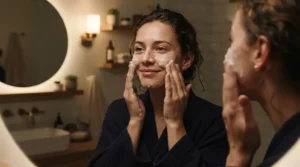
Here’s the adapted structure: cleanse morning and night with your BHA soap bar, lathering in your hands first rather than rubbing the bar directly on your face (this avoids over-depositing salicylic acid on any one spot and keeps the wash time short — 30 to 60 seconds of contact is typically plenty). Rinse thoroughly, pat dry rather than rub, and apply a fragrance-free, non-comedogenic moisturizer immediately while skin is still slightly damp to lock in hydration before the BHA’s mild drying effect sets in. If you’re also using a treatment product like benzoyl peroxide or a retinoid, apply it after moisturizing has settled, not before — layering actives on freshly BHA-washed skin is the single most common way people accidentally overdo it and end up with the redness and peeling they were trying to avoid.
The acne.org philosophy’s biggest lesson isn’t the specific products, it’s consistency without escalation: pick one cleansing bar, stick with it daily, and resist the urge to add three more “boosting” products the moment you don’t see overnight results. Skin cell turnover takes weeks, not days, and switching formulas every ten days resets that clock every single time.
Real-World Scenarios: Matching the Bar to the Person
Not every “best for acne” claim applies equally to every situation, so here’s how these seven bars map onto a few common real-life profiles.
If you’re a college student sharing a communal dorm shower and dealing with occasional back and chest breakouts from stress and dining-hall food, the Asepxia Scrub Deep Cleansing Bar Soap or the value-packed DermaHarmony 2% Salicylic Acid Bar Soap make the most financial and practical sense — cheap enough to not stress over sharing a shower caddy, strong enough for body acne, and simple enough to not require a skincare-savvy routine you don’t have time for between classes.
If you’re managing eczema-adjacent sensitive skin alongside occasional hormonal breakouts, budget takes a backseat to formulation, and the CeraVe SA Cleansing Bar is the clear match — its ceramide-forward approach directly addresses the barrier concerns that make sensitive, acne-prone skin such a frustrating combination to shop for. And if you’re an adult dealing with persistent, resistant jawline breakouts who has already tried gentler options without much change, the DermaHarmony 10% Sulfur & 3% Salicylic Acid Bar or a step up to a dermatologist visit is the more honest next move — sometimes an OTC bar soap genuinely isn’t enough, and that’s worth acknowledging rather than promising results a product can’t consistently deliver.
✨ Ready to try one for yourself?
Click through to check today’s availability before your skin routine takes another detour! 🧼
How to Choose the Best Exfoliating Acne Soap Bars for Your Skin Type
Picking between exfoliating acne soap bars comes down to matching formulation strength to what your skin can actually tolerate, not just chasing the highest percentage on the label. Here’s a practical framework:
- Identify your primary acne type first. Blackheads and whiteheads respond well to salicylic acid alone; inflamed, cystic breakouts often need the added antimicrobial punch of a sulfur-salicylic combination or a benzoyl peroxide product used alongside it.
- Check for barrier-support ingredients if you’re prone to dryness. Ceramides, hyaluronic acid, and shea butter aren’t marketing filler — they measurably offset the drying effect that comes standard with any effective BHA formula.
- Consider whether you want physical exfoliation too. Jojoba beads or charcoal add a mechanical component; that’s a plus for oily, resilient skin and a potential irritant for reactive skin.
- Match concentration to your experience level. First-timers do better starting around 0.5%-2% salicylic acid rather than jumping straight to a sulfur-combo bar.
- Factor in where you’ll use it. A fragrance-free, gentle bar makes more sense for facial use; a stronger, scented formula is more forgivable on the back and chest.
- Read the aggregated review themes, not just the star rating. A 4.6-star product with recurring complaints about a specific issue relevant to your skin (dryness, scent, texture) tells you more than the average number alone.
- Budget for the moisturizer too. The soap is half the equation — pairing it with the wrong (or no) moisturizer is the most common reason people conclude “this didn’t work.”
BHA Soap for Acne vs Benzoyl Peroxide Soap
The BHA-versus-benzoyl-peroxide debate comes up constantly, and the honest answer is that they’re not really competing for the same job. Benzoyl peroxide works primarily by killing acne-causing bacteria and is generally considered the more aggressive, faster-acting option against inflammatory acne — it’s also notorious for bleaching towels, pillowcases, and dark fabric, a real practical downside that salicylic acid soap simply doesn’t have.
Salicylic acid, by contrast, works through its oil-soluble, keratolytic action — dissolving the debris that clogs a pore in the first place, rather than attacking bacteria directly. That makes BHA soap for acne generally milder and better suited to blackheads, whiteheads, and general pore congestion, while benzoyl peroxide tends to outperform it for red, inflamed pustules and papules. A randomized split-face clinical study comparing a BHA-and-retinol regimen against a benzoyl peroxide-based routine found the two approaches reduced total acne lesions by a similar margin over 12 weeks, though the BHA-based routine was rated more tolerable and preferable by participants overall.
In practice, plenty of people use both: a salicylic acid bar soap as the daily cleansing step, followed by a spot-applied benzoyl peroxide treatment where inflammation is worst. That layered approach captures both mechanisms without doubling up on a single one, which is generally gentler on skin than reaching for maximum-strength versions of either ingredient alone.
Pore-Clearing Exfoliation: What’s Actually Happening Under Your Skin
“Pore-clearing exfoliation” sounds like marketing language, but the mechanism behind it is genuinely specific. A pore becomes clogged when a mix of sebum (skin oil) and dead skin cells hardens inside the follicle, sometimes trapping bacteria along with it. Salicylic acid’s oil solubility means it can actually penetrate that oily plug rather than sitting on top of it the way a water-based exfoliant would, gradually breaking down the bond holding dead cells together so they shed more easily.
What that means day-to-day: you generally won’t see a dramatic, single-wash transformation. What most people report instead is a gradual reduction in blackhead density and smaller, less-raised whiteheads over two to six weeks of consistent use, as pores that were mid-clog get cleared before they progress into a full breakout. The visible “tingle” some formulas produce isn’t actually a sign of it working harder — it’s simply a mild irritation response, and a formula that tingles intensely isn’t necessarily more effective than one that doesn’t.
It’s also worth setting expectations honestly: salicylic acid soap manages and prevents new clogs better than it “fixes” acne that’s already inflamed and painful. For active cystic breakouts, exfoliation alone typically isn’t enough, and combining it with an anti-inflammatory or antimicrobial ingredient — or seeing a dermatologist for anything moderate to severe — tends to produce better results than expecting one bar of soap to do everything.
Common Mistakes When Buying Salicylic Acid Bar Soap for Acne
Even with the right ingredient, plenty of people undermine their own results. A few recurring pitfalls to sidestep: buying the highest available concentration assuming “stronger is always better,” when jumping straight to a 3% sulfur-and-salicylic combo without prior BHA experience often causes irritation that gets blamed on the product rather than the pace of introduction. Skipping the moisturizer step entirely is another near-universal mistake — salicylic acid’s drying effect is a feature of how it works, not a flaw, but only if it’s balanced with hydration afterward.
People also frequently scrub with the bar itself directly against the skin rather than lathering in the hands first, which concentrates the active ingredient unevenly and increases the odds of irritation on the same few spots repeatedly. And a subtler mistake: judging a bar as “not working” after three or four days, when meaningful pore-clearing results typically take two to six weeks to become visible, in line with normal skin cell turnover timelines. Finally, ignoring the difference between facial-formulated bars and body-acne bars can backfire — some sulfur-forward or heavily charcoal-loaded formulas are genuinely too aggressive for daily facial use even if they’re fine on the back and chest.
Salicylic Acid Bar Soap for Sensitive Skin, Teens, and Body Acne
Different users need genuinely different formulas here, not just different marketing. For sensitive or barrier-compromised skin, ceramide-and-hyaluronic-acid formulas like the CeraVe SA Cleansing Bar are the safer starting point — the added barrier support directly counters the tightness that pure-soap bars can cause on reactive skin. Teens dealing with first-time hormonal breakouts generally do best starting with a lower-concentration, fragrance-free option like the DermaHarmony 2% Salicylic Acid Bar Soap, since younger skin hasn’t built up tolerance to actives yet and a gentle introduction reduces the odds of quitting after one bad reaction.
For body acne specifically — back, chest, shoulders — thicker skin in those areas generally tolerates stronger formulas better than the face does, which is where options like Asepxia Scrub Deep Cleansing Bar Soap or the DermaHarmony 10% Sulfur & 3% Salicylic Acid Bar earn their keep. A practical tip that doesn’t show up on any label: let the lather sit on body acne areas for a full 60 to 90 seconds before rinsing, longer than most people naturally wash, since contact time matters more for BHA penetration than aggressive scrubbing does.
Long-Term Cost & Maintenance: Is Bar Soap Cheaper Than Liquid Cleanser?
Cost-per-use is where bar soap quietly wins against liquid acne cleansers, and it’s worth running the numbers rather than assuming. A typical 4 oz salicylic acid bar used once or twice daily tends to last four to six weeks depending on bar size and household humidity (soap dishes matter — a bar left sitting in water dissolves faster, cutting its lifespan noticeably). Compare that to a liquid cleanser, where a pump or two per wash empties a similarly priced bottle in roughly the same timeframe, but with added plastic packaging cost baked into the price and more product wasted down the drain per use.
Where bar soap’s economics get less favorable is with the premium options — a $20-plus Clinique Acne Solutions Cleansing Bar doesn’t necessarily last meaningfully longer than a $7 DermaHarmony bar, since usage habits (how long you lather, how often you use it) matter more than price point for longevity. The genuine long-term maintenance consideration is storage: keeping bars dry between uses on a well-draining soap dish extends their life significantly and also reduces the bacterial buildup that can happen on a perpetually soggy bar sitting in standing water.
Frequently Asked Questions
❓ Does salicylic acid bar soap really work for acne?
❓ Can I use salicylic acid soap every day?
❓ Is salicylic acid soap better than benzoyl peroxide soap?
❓ Will salicylic acid bar soap dry out my skin?
❓ How long until I see results from acne soap?
Conclusion
There’s no single “best” salicylic acid bar soap for acne, because there’s no single type of acne-prone skin — what clears a college student’s back breakouts isn’t the same formula that a barrier-compromised, sensitive-skinned adult should be reaching for. What the research consistently supports is the underlying mechanism: salicylic acid’s oil solubility genuinely does something a plain cleanser can’t, working its way into clogged pores rather than just washing the surface. Whether you start with a $7 fragrance-free basic or work up to a dermatologist-developed encapsulated formula, the bigger factor in your results will always be consistency, proper moisturizing, and realistic expectations about how long meaningful change actually takes.
If you’re just starting out, a gentle, lower-concentration option paired with a solid moisturizer is the safer on-ramp than jumping straight to the strongest bar on the shelf. And if you’ve genuinely given a BHA soap routine six to eight weeks without improvement, that’s a legitimate signal to loop in a dermatologist rather than cycling through five more OTC products hoping one sticks.
Recommended for You
- Tea Tree Oil Soap For Acne-Prone Skin: 7 Best Picks In 2026
- 7 Best Sulfur Soap Bar Reviews For Acne In 2026
- Acne Bar Soap: 7 Budget Picks That Actually Work In 2026
Disclaimer: This article contains affiliate links. As an Amazon Associate, I earn from qualifying purchases. If you purchase products through these links, we may earn a small commission at no additional cost to you.
✨ Found this helpful? Share it with your friends! 💬🤗
