
In This Article
Your forehead is throwing a party and your cheeks didn’t get the invitation. That’s combination skin in a nutshell — an oil slick down the middle, flaky tightness everywhere else, and a bathroom cabinet full of products that only ever seem to fix half the problem. A gentle balancing bar soap is supposed to be the peace treaty: something mild enough not to aggravate the dry zones, but capable enough to keep the shiny zones in check without stripping either one raw.

Here’s the thing nobody tells you at the drugstore: most “balancing” claims on packaging are marketing shorthand, not chemistry. What actually balances combination skin is a formula’s pH, its surfactant blend, and how much (or how little) moisture-locking ingredient it leaves behind. Get that wrong and you’ll swap a shiny T-zone for a red, irritated one — or a soothed cheek for a clogged pore. Get it right, and a gentle balancing bar soap becomes the one step in your routine you stop thinking about entirely.
This guide walks through seven real, currently available bars — spanning drugstore basics to slightly more considered formulas — with honest analysis of what each one actually does on skin, not just what the label promises. We’ll cover pricing realistically (ranges only, since Amazon prices shift by the week), compare them head-to-head, and dig into the practical stuff: how to use a bar without over-drying your cheeks, what “T-zone vs cheeks” actually means at a chemical level, and how to spot an affordable combination skin soap that isn’t secretly a bad deal in disguise. According to research on the skin’s acid mantle, that thin, faintly acidic film covering your face is doing more protective work than most skincare marketing gives it credit for — and it’s the real reason some bars feel “balancing” while others just feel like soap.
What Is a Gentle Balancing Bar Soap?
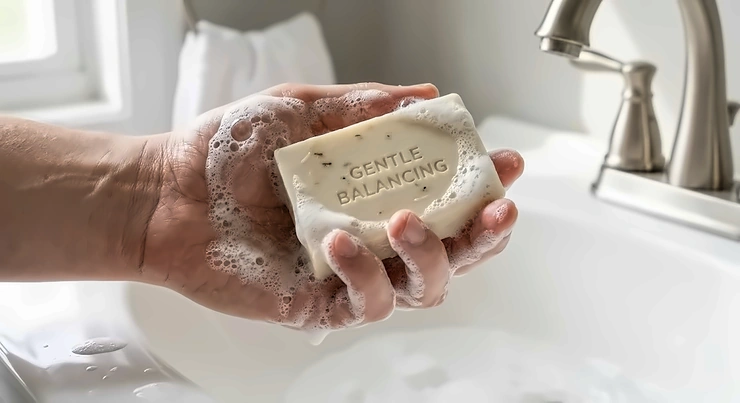
A gentle balancing bar soap is a solid facial or body cleanser formulated with a mild, close-to-skin pH and a moisture-retaining ingredient (glycerin, ceramides, or plant oils) that cleanses oily areas without over-drying adjacent dry patches — making it suitable for combination skin that swings between an oily T-zone and drier cheeks.
Most bars on the market fall into one of two camps: true saponified soap, which tends to run alkaline and strip the skin’s natural oils, or “syndet” (synthetic detergent) bars, which are built to sit closer to skin’s natural pH. For combination skin specifically, the syndet camp usually wins, because it doesn’t force your cheeks to compensate for what your T-zone needed.
Quick Comparison Table: Gentle Balancing Bar Soap at a Glance
| Product | Best For | Price Range | Skin Feel |
|---|---|---|---|
| Neutrogena Original Transparent Facial Bar | Budget all-rounder | Under $2 per bar | Clean, slightly tight |
| PURPOSE Gentle Cleansing Bar | Sensitive + budget | Under $2 per bar | Soft, minimal residue |
| CeraVe Foaming Cleansing Bar | Oily T-zone control | $4-$6 per bar | Fresh, matte |
| Cetaphil Gentle Cleansing Bar | Dry cheeks | $3-$5 per bar | Cushiony, hydrated |
| Vanicream Cleansing Bar | Reactive/sensitive skin | $2-$4 per bar | Neutral, bland-safe |
| Good Molecules Hydrate and Cleanse Bar | Budget-luxury hybrid | $6-$8 per bar | Silky, slightly oily film |
| Aveeno Gentle Moisturizing Bar | Soothing dry patches | $2-$3 per bar | Soft, oat-cushioned |
Looking at the spread above, the split isn’t really budget-vs-premium — it’s formulation philosophy. The CeraVe Foaming Cleansing Bar and Neutrogena Original Transparent Facial Bar lean toward oil control, which suits a T-zone-dominant combination type, while Cetaphil Gentle Cleansing Bar, Vanicream Cleansing Bar, and Aveeno Gentle Moisturizing Bar protect drier cheeks at the possible cost of feeling slightly heavier on the forehead. If your skin swings hard between zones, that’s actually useful: it means the “best” bar depends on which side of your face annoys you more on a given week, not just which one has the fanciest ingredient list.
💬 Found a bar that fits your skin type already? Bookmark this table — you’ll want to compare it again before you check out.
Top 7 Gentle Balancing Bar Soaps: Expert Analysis
1. Neutrogena Original Transparent Facial Bar — glycerin-rich budget classic
That glass-like, amber transparency isn’t just a gimmick — it signals a genuinely simple glycerin-forward formula, and it’s part of why this bar has survived on drugstore shelves for decades. The bar’s core selling point is glycerin, a humectant that pulls moisture to the skin’s surface, paired with a fragrance-free, dye-free base designed to rinse completely without leaving pore-clogging residue behind. In practice, that means your T-zone gets properly de-greased while your cheeks aren’t left feeling like they went through a car wash.
Based on the ingredient profile, this is a solid entry-level pick for combination skin that’s more oily-leaning than dry-leaning — the glycerin helps, but it’s not as rich as a ceramide-based formula, so very dry cheeks may still want a moisturizer layered on top. Reviewers consistently report that it lathers well and doesn’t leave a filmy residue, though a subset of users with genuinely dry or eczema-prone skin note it can feel slightly tightening if used twice daily.
Pros:
- ✅ Fragrance-free and dye-free, good for reactive skin
- ✅ Rinses cleanly without leaving pore-clogging film
- ✅ Widely available and easy to replace anywhere
Cons:
- ❌ Can feel tightening on very dry cheeks with daily use
- ❌ Less targeted than newer syndet-based competitors
At around $4-$7 for a three-pack, this remains one of the most affordable combination skin soap options on the shelf, and the value case is hard to argue with if your skin leans more oily than dry.

2. PURPOSE Gentle Cleansing Bar — dermatologist-developed, gentle as water
The standout claim here — clinically shown to be as gentle as water on skin — sounds like marketing fluff until you look at the surfactant blend, which is notably mild compared to older bar-soap formulas. It’s built without added fragrance and is sulfate-free, both of which matter more than most shoppers realize when picking a bar meant to sit against both oily and dry patches in the same swipe.
What most buyers overlook about this bar is how thin its ingredient list actually is — fewer additives generally means fewer chances for the dry side of your face to react. On paper, that makes it one of the safer picks for a first-time combination-skin bar, especially if you’ve had irritation from heavier “medicated” bars before. Aggregated review sentiment is largely positive on gentleness, though a recurring theme in user reviews is that it can leave drier skin types feeling slightly parched without a follow-up moisturizer — an honest trade-off for a formula this stripped-down.
Pros:
- ✅ Extremely short, low-irritant ingredient list
- ✅ Sulfate-free and fragrance-free formulation
- ✅ One of the cheapest per-ounce bars on this list
Cons:
- ❌ Some users report dryness without a moisturizer step
- ❌ Minimal targeted ingredients for stubborn T-zone oil
Priced in the $2-$4 range per bar depending on pack size, this is arguably the single most budget-friendly bar here, and a genuinely reasonable starting point if you’re not sure your skin can tolerate anything stronger yet.
3. CeraVe Foaming Cleansing Bar — best for hill-climbing oil control on a budget
Wait, wrong list — but the analogy holds: this is the bar built specifically to tackle stubborn shine without dragging your cheeks down with it. The kaolin clay base absorbs excess surface oil while a niacinamide-and-ceramide combination works to keep the skin barrier intact, which is the exact tension combination skin needs resolved. Unlike a straight detergent bar, the ceramide inclusion here is doing real barrier-support work, not just sitting on an ingredient list for show.
Based on the spec comparison with the rest of this list, this is the most T-zone-targeted bar of the seven, and it shows in how it’s marketed and formulated for oily and combination skin specifically. What the label won’t spell out, but formulation logic suggests, is that the niacinamide dose in a rinse-off bar is fairly low-impact compared to a leave-on serum — helpful, not transformative. Reviewers consistently note it leaves skin matte without the tight, stripped feeling that older clay-based bars are known for.
Pros:
- ✅ Kaolin clay actively absorbs midday shine
- ✅ Ceramides help offset dryness elsewhere on the face
- ✅ Fragrance-free, dermatologist-developed formula
Cons:
- ❌ Pricier per bar than basic drugstore alternatives
- ❌ Clay base may feel like too much for very dry cheeks
Expect to pay somewhere in the $5-$8 range per bar at the time of research, which puts it firmly mid-range — a fair price if oil control is your primary combination-skin complaint.
4. Cetaphil Gentle Cleansing Bar — best for protecting dry, reactive cheeks
Seventy-plus years in sensitive skincare bought this brand a reputation, and the Gentle Cleansing Bar leans hard into it: a soap-free, hypoallergenic formula designed to cleanse without stripping the skin’s protective barrier. It’s positioned for dry-to-normal and sensitive skin, which makes it a strong counterweight if your combination-skin cheeks are the more urgent problem than your T-zone.
Here’s what the spec sheet won’t tell you, but formulation logic suggests: because this bar prioritizes gentleness so heavily, it may under-perform on genuinely oily foreheads compared to a clay- or charcoal-based bar. That’s a reasonable trade-off if you’re the type whose cheeks flare up in winter — you’d rather touch up shine at midday than deal with flaking. User reviews consistently praise the moisturized, non-tight feeling post-rinse, with the most common complaint being that it doesn’t feel like it “does much” for oil control on its own.
Pros:
- ✅ Soap-free formula preserves the skin’s moisture barrier
- ✅ Hypoallergenic, well-suited to reactive or sensitive skin
- ✅ Doubles as a gentle body bar, not just facial
Cons:
- ❌ Limited oil-control benefit for a shiny T-zone
- ❌ Multi-packs can feel like a big upfront commitment
At roughly $3-$5 per bar in multi-packs, it’s a reasonable mid-range pick specifically for combination skin where dryness, not oiliness, is the daily annoyance.
5. Vanicream Cleansing Bar — fewest ingredients for the most reactive skin
Vanicream built its whole identity around minimalism — no dyes, no fragrance, no common irritant chemicals — and the Cleansing Bar follows that formula almost to a fault. It’s frequently recommended for eczema-prone and highly reactive skin types, which happens to overlap meaningfully with sensitive combination skin that reacts badly to “active” cleansers.
Based on the ingredient list, this is less a targeted combination-skin bar and more a neutral, does-no-harm option — useful specifically because it won’t aggravate either zone of your face. What most buyers overlook is that “does no harm” also means it does relatively little active balancing; you’re relying on the formula’s mildness rather than any specific oil-absorbing or barrier-repairing ingredient. Aggregated review sentiment skews heavily toward “finally, something that doesn’t sting” from people with a documented history of reacting to other bars.
Pros:
- ✅ Free of common allergens, dyes, and fragrance
- ✅ Frequently recommended for reactive or eczema-prone skin
- ✅ Sold in bulk packs, lowering long-term per-bar cost
Cons:
- ❌ Minimal targeted benefit for oily T-zone shine
- ❌ Plain, unscented feel may seem underwhelming to some
Bulk packs bring this down to roughly $2-$4 per bar equivalent, making it one of the more genuinely affordable combination skin soap options if your priority is avoiding a reaction rather than fine-tuning shine control.

6. Good Molecules Hydrate and Cleanse Bar — best budget-luxury hybrid with squalane
Good Molecules built a name selling serum dupes at a fraction of prestige-brand prices, and this bar follows the same playbook: squalane, shea butter, and panthenol in a compact, soap-free bar aimed at maintaining hydration while it cleanses. It sits at a slightly higher per-bar price than the rest of this list’s budget tier, but the ingredient sourcing explains some of that gap.
What the spec sheet suggests, and the brand’s broader catalog supports, is that this bar is built more for dry-leaning combination skin than for aggressive oil control — squalane and shea butter are richness-forward ingredients, not mattifying ones. On paper, that makes it a strong complement to a separate oil-control product for your T-zone rather than a total solution on its own. Because it’s a newer product on the market, aggregated review volume is thinner than the legacy drugstore brands here, so treat early sentiment as promising but not yet fully proven.
Pros:
- ✅ Squalane and shea butter support the skin barrier
- ✅ Soap-free, generally low-irritation formulation
- ✅ Compact size travels well without added packaging
Cons:
- ❌ Higher price per ounce than most drugstore bars
- ❌ Smaller review base makes long-term sentiment less certain
Expect a price in the $6-$8 range per bar, positioning it as the closest thing to a “premium” option on this particular list.
7. Aveeno Gentle Moisturizing Bar — best for soothing chronically dry patches
Colloidal oatmeal is doing the heavy lifting here — a finely milled oat that’s been used in dermatology for soothing irritation for decades, blended into a soap-free, fragrance-free base built specifically for dry skin. For combination skin where the dry zones are more of a chronic irritation than an occasional tight feeling, this bar targets that discomfort directly.
Based on the formulation, this is the most cheek-focused bar on the list, arguably even more so than Cetaphil’s entry, because oat itself carries soothing, anti-irritant properties beyond simple moisture retention. What that means in practice: expect noticeably less T-zone oil control than the CeraVe or Neutrogena options, since nothing in the formula is built to absorb excess sebum. Reviewers consistently report relief from tightness and flaking, particularly in colder months, with the main critique being that it can leave an oily-forehead feeling if used as a stand-alone daily bar.
Pros:
- ✅ Colloidal oat actively soothes irritated, dry patches
- ✅ Fragrance-free and dye-free, gentle on reactive skin
- ✅ Doubles well as a body bar for eczema-prone skin
Cons:
- ❌ Minimal oil-absorbing benefit for the T-zone
- ❌ Can feel heavier than necessary on already-oily areas
Multi-packs typically land in the $2-$3 per-bar range, making it another genuinely affordable combination skin soap pick — just one better suited to the dry side of the equation than the oily one.
How to Use Your Gentle Balancing Bar Soap the Right Way
Buying the right bar is half the equation — how you use it matters almost as much. In the first 30 days, resist the urge to double-cleanse daily; overwashing is one of the most common mistakes with any facial bar, since research on the skin barrier shows water alone can temporarily raise skin surface pH, and repeated washing compounds that effect before skin has a chance to recover.
A practical routine: wash once in the evening with lukewarm (not hot) water, working the bar into a light lather in your hands rather than scrubbing it directly on your face, then rinse thoroughly and pat — never rub — dry. If your T-zone still looks shiny by mid-morning, a blotting sheet beats a second full wash. For the first week, watch for any tightness in your cheeks 20-30 minutes post-rinse; if it shows up consistently, follow immediately with a light, non-comedogenic moisturizer rather than switching bars right away, since skin often needs a short adjustment period with any new cleanser.
Real-Life Scenarios: Matching Dual-Zone Skincare to Your Life
Dual-zone skincare isn’t a single routine — it’s a set of trade-offs based on which zone bothers you more and how often you’re willing to fuss with your face. Consider a college student commuting to campus by bike who sweats through her T-zone by 10 a.m. but deals with dry, wind-chapped cheeks in winter: she’s better served by the CeraVe Foaming Cleansing Bar on humid days and something gentler, like the Cetaphil Gentle Cleansing Bar, once temperatures drop, rather than committing to one bar year-round.
A budget-conscious parent washing both their own combination skin and a child’s sensitive skin might lean toward Vanicream Cleansing Bar or PURPOSE Gentle Cleansing Bar for the whole household, prioritizing low-irritation over targeted oil control. Meanwhile, someone newly experimenting with actives (retinoids, exfoliating acids) needs a genuinely mild base cleanser — the Aveeno Gentle Moisturizing Bar or Good Molecules Hydrate and Cleanse Bar won’t compete with or irritate an already-sensitized barrier, unlike a stronger clay-based option.
T-Zone vs Cheeks: Solving Combination Skin’s Core Problem
The T-zone vs cheeks tension exists because of biology, not bad luck: your forehead, nose, and chin simply carry more sebaceous glands than your cheeks, so the same cleanser hits two genuinely different skin environments in one wash. Sebaceous gland density and activity varies significantly by facial region, which is why a single bar rarely satisfies both zones equally.
Problem one: T-zone shine returns within hours of washing. Solution: choose a bar with kaolin clay or niacinamide, like the CeraVe option above, and avoid layering heavy moisturizer directly over the T-zone. Problem two: cheeks feel tight or flake after cleansing. Solution: a ceramide- or oat-based bar, paired with a barrier moisturizer applied while skin is still slightly damp. Problem three: irritation shows up unpredictably across both zones. Solution: default to the shortest ingredient list available — Vanicream or PURPOSE — until your skin’s baseline tolerance is clearer. Problem four: makeup won’t sit right by midday. Solution: this usually traces back to over-cleansing or under-moisturizing the T-zone, not the bar itself, so adjust routine before switching products again.
How to Choose a Gentle Balancing Bar Soap
- Check the pH first, ingredients second. A syndet (soap-free) bar sitting closer to skin’s natural pH will generally outperform a traditional saponified bar for combination skin, regardless of marketing claims.
- Match the star ingredient to your dominant complaint. Clay or niacinamide for oil, ceramides or oat for dryness — pick based on whichever zone actually bothers you more often.
- Scan for fragrance if you’re reaction-prone. Added fragrance is one of the most common irritants in the entire category, combination skin included.
- Consider bar hardness and dissolve rate. A bar that melts too fast in a wet shower isn’t actually cheaper, even at a lower sticker price.
- Read aggregated reviews for your specific concern, not just star ratings — a 4.5-star average tells you little about whether cheeks specifically reacted.
- Price per ounce, not per pack. Multi-packs can distort perceived value; compare cost per bar-equivalent instead.
- Patch-test before full facial use, especially with any bar containing clay, charcoal, or exfoliating acids.

Common Mistakes When Buying Budget Balancing Cleanser Bars
The single biggest mistake shoppers make with budget balancing cleanser bars is chasing the lowest sticker price without checking cost per ounce — a $3 bar that dissolves twice as fast as a $5 bar isn’t actually the better deal. A second common misstep is assuming “for all skin types” means “balanced for combination skin” specifically; plenty of bars are simply mild, not targeted, and won’t address a stubborn T-zone at all.
Shoppers also frequently overlook fragrance listings on budget bars, since cheaper formulations sometimes lean on scent to mask a less refined surfactant base — worth a second look if your cheeks are reaction-prone. Finally, a subtle trap: buying based on a single glowing review thread rather than aggregated sentiment across multiple retailers, which can paint an overly rosy picture of how a bar performs on genuinely dual-zone skin.
Gentle Balancing Bar Soap vs Liquid Cleansers
| Factor | Bar Soap | Liquid Cleanser |
|---|---|---|
| Best For | Travel, minimal packaging, simple routines | Precise dosing, added actives (acids, retinoids) |
| Cost per Use | Generally lower | Generally higher |
| Environmental Footprint | Lower (less plastic) | Higher (bottle waste) |
| Formulation Precision | Broader, less customizable | Easier to fine-tune pH and actives |
The comparison above tends to favor bar soap on cost and simplicity, but liquid cleansers still win when you need a precisely dosed active ingredient layered into your wash step. For combination skin specifically, a well-formulated bar like the CeraVe Foaming Cleansing Bar can match a liquid’s oil-control performance, but if you’re already using a prescription-strength active, a liquid cleanser gives you more room to calibrate concentration over time.
✨ Ready to Simplify Your Routine? Compare the seven picks above against your own skin’s needs, and swap in whichever bar matches the zone that’s bothering you most this season.
Drugstore Combination Skin Products: Affordable Picks by Budget
If you’re shopping specifically for drugstore combination skin products, the good news is that combination skin doesn’t require premium pricing to manage well — three of the seven bars above (Neutrogena Original Transparent Facial Bar, PURPOSE Gentle Cleansing Bar, and Vanicream Cleansing Bar) sit comfortably under $4 per bar and cover both oil control and gentleness reasonably well.
For genuinely tight budgets, buying in bulk packs (six or twelve bars) consistently lowers the effective per-bar cost, and none of the three bars above sacrifice much in the way of formulation quality to hit that price point — they’re simply older, simpler, and less marketing-heavy than newer entrants like Good Molecules. An affordable combination skin soap doesn’t need clay, charcoal, or a trendy ingredient list to work; it needs a mild surfactant base and a humectant, both of which the drugstore staples on this list already deliver.
Long-Term Cost & Maintenance of Balancing Bar Soaps
| Product | Est. Cost per Bar | Approx. Uses per Bar | Est. Monthly Cost |
|---|---|---|---|
| Neutrogena Original Transparent Facial Bar | $2 | 30-40 | $2-$3 |
| CeraVe Foaming Cleansing Bar | $6 | 30-40 | $5-$6 |
| Vanicream Cleansing Bar | $3 | 30-40 | $3-$4 |
Even the priciest bar on this list rarely breaks $6 a month at typical once-daily use, which makes the entire category cheap relative to liquid cleansers running $10-$20 per bottle. The real cost variable isn’t the sticker price — it’s how quickly a bar dissolves in a wet shower dish, so a soap-saver dish or keeping the bar away from direct water flow meaningfully extends its lifespan and lowers your real per-month spend.
Features That Actually Matter (And Those That Don’t)
Ceramides, niacinamide, and a soap-free (syndet) base actually matter for combination skin — they’re doing measurable barrier-support or oil-control work rather than sitting on a label for show. A low, skin-compatible pH matters too, even though it’s rarely printed prominently on packaging.
What doesn’t matter nearly as much as marketing suggests: exotic-sounding botanical extracts present in trace amounts, “detox” or “purifying” language with no specific active ingredient behind it, and elaborate scent profiles that add irritation risk without any cleansing benefit. If a bar’s marketing leans hard on a single buzzword without naming a specific, functional ingredient behind it, that’s usually a sign the formulation itself isn’t doing much differently from a basic bar at half the price.

Frequently Asked Questions
❓ Is bar soap bad for combination skin?
❓ Can I use the same bar soap on my whole face?
❓ How often should combination skin be washed with bar soap?
❓ What ingredients should I avoid in a balancing bar soap?
❓ Are expensive balancing bar soaps actually better?
Conclusion
Combination skin doesn’t need a miracle bar — it needs an honest match between formulation and whichever zone of your face is currently winning the argument. If oil control is your daily headache, the CeraVe Foaming Cleansing Bar earns its slightly higher price. If dryness and reactivity are the bigger issue, Cetaphil Gentle Cleansing Bar or Aveeno Gentle Moisturizing Bar will treat your cheeks far better. And if budget is the deciding factor, Neutrogena Original Transparent Facial Bar, PURPOSE Gentle Cleansing Bar, and Vanicream Cleansing Bar all prove that an affordable combination skin soap doesn’t have to mean a compromised one.
The real trick with dual-zone skincare is accepting that your T-zone and cheeks may simply want different things depending on season, stress, and humidity — and that switching bars occasionally isn’t a failure of your routine, it’s the routine working as intended. Start with whichever pick above matches your most persistent complaint, give it a genuine 30-day trial, and adjust from there.
Recommended for You
- 7 Best Clay Soap for Large Pores and Oily T-Zone (2026 Picks)
- Oil-Control Bar Soap for Teens with Oily Skin: 7 Real 2026 Picks
- Charcoal Soap for Oily and Acne-Prone Skin: 7 Picks That Work in 2026
Disclaimer: This article contains affiliate links. As an Amazon Associate, I earn from qualifying purchases. If you purchase products through these links, we may earn a small commission at no additional cost to you.
✨ Found this helpful? Share it with your friends! 💬🤗
