
In This Article
Winter air didn’t do this to your hands. Neither did one bad batch of dish soap. If your knuckles are splitting, your palms feel like sandpaper, and lotion barely makes a dent by lunchtime, the real culprit is probably sitting by your sink right now — the soap you reach for twenty-plus times a day. Most bar soap is built to strip oil, not preserve it, and every wash quietly erodes the lipid layer that keeps your skin flexible. That’s exactly why the search for a genuinely good cream bar soap for extremely dry hands matters so much more than it sounds.
Here’s the short version: a true cream bar soap for extremely dry hands blends emollients like glycerin, ceramides, shea butter, or cocoa butter directly into the cleansing base, so the bar hydrates while it cleans instead of fighting against your skin barrier. That distinction — cushiony cream base versus stripping detergent base — is the whole ballgame for anyone whose hands are past ordinary dryness and into cracked, painful territory.
We spent hours digging through real product formulations, dermatologist commentary, and aggregated customer feedback to build this guide. Below you’ll find seven real, currently available bars spanning budget to premium, a breakdown of what actually separates a cream bar from a regular one, and dedicated sections on cracked-hand care, healthcare-worker-specific washing demands, occupational dermatitis, hand sanitizer overuse, and the cuticle damage most guides completely ignore. According to the American Academy of Dermatology, frequent handwashing is one of the most common triggers of chronic hand dryness — which makes the soap itself, not just the lotion you slather on afterward, the actual front line of defense.
Quick Comparison Table
Before the deep dive, here’s the fast version for anyone who just wants a starting point. Each of these bars earned its spot for a distinct reason, and the “best for” column should steer you toward the right one in about ten seconds flat.
| Product | Best For | Standout Ingredient | Price Range |
|---|---|---|---|
| Vanicream Cleansing Bar | Eczema-prone or reactive skin | Zero fragrance/dyes, NEA Seal | $10-$16 (multi-pack) |
| CeraVe Hydrating Cleansing Bar | Barrier repair, ceramide fans | 3 ceramides + hyaluronic acid | $12-$20 (multi-pack) |
| Cetaphil Gentle Cleansing Bar | Frequent washers, healthcare use | Soap-free, dermatologist-recommended | $10-$18 (multi-pack) |
| Dove Sensitive Skin Beauty Bar | Budget-conscious households | 1/4 moisturizing cream | $7-$12 (multi-pack) |
| Nivea Creme Care Soap Bar | Softness plus a pleasant scent | Eucerit and almond oil | $8-$12 (3-pack) |
| Palmer’s Cocoa Butter Cream Soap | Rough, cracked, or scarred hands | Cocoa butter + vitamin E | $5-$9 per bar |
| Yardley Moisturizing Bar Cocoa Butter | Best value multi-pack | Cocoa and shea butter blend | $10-$16 (multi-pack) |
Looking at the spread, there’s a clear split between soap-free syndet bars (Vanicream, CeraVe, Cetaphil) built for compromised or eczema-adjacent skin, and true cream-enriched soaps (Palmer’s, Yardley, Nivea) that lean on butters for a richer, more indulgent lather. Neither category is objectively “better” — the right pick depends on whether your dryness comes with active irritation or just needs a moisture boost. If you’re not sure which camp you’re in, the how-to-choose section further down walks through exactly how to tell.
💬 Found a pick you like already? Jump straight to it below — every product name links to more detail.
Top 7 Cream Bar Soaps for Extremely Dry Hands: Expert Analysis
We picked these seven specifically to cover the full range of dry-hand severity, from mild seasonal tightness to genuinely cracked, painful skin. Budget, mid-range, and premium options are all represented, and each one has real, verifiable formulation details behind it — no invented specs, no copied listing text.
1. Vanicream Cleansing Bar — fragrance-free pick built for reactive skin
If your dryness comes bundled with redness, itching, or a dermatologist diagnosis somewhere in your history, this is the bar to start with. Vanicream Cleansing Bar skips fragrance, dyes, and even botanical extracts entirely, relying instead on the brand’s proprietary Vanicream Cream Base and gentle isethionate cleansers to lift dirt without disrupting the skin barrier. That “nothing extra” ingredient philosophy sounds boring until you realize fragrance and plant extracts are two of the most common triggers for contact irritation on already-compromised skin — cutting them out isn’t a marketing gimmick, it’s the entire point.
Reviewers consistently note that Vanicream Cleansing Bar leaves hands feeling clean rather than tight, which matters because “squeaky clean” is usually a sign your skin barrier just got stripped. Based on the ingredient list, this bar is best suited to people managing eczema, rosacea, or dermatologist-diagnosed sensitive skin, and it’s earned the National Eczema Association’s Seal of Acceptance — a credential that requires actual clinical irritation testing, not just a marketing claim. It’s also become a go-to among people with genuinely reactive skin precisely because it doesn’t try to smell nice or feel luxurious; it just avoids causing problems.
Pros:
- ✅ Zero fragrance, dyes, or plant extracts to trigger flare-ups
- ✅ Carries the National Eczema Association Seal of Acceptance
- ✅ Dermatologist-favored for eczema and rosacea-prone hands
Cons:
- ❌ Lather feels noticeably thinner than richer cream soaps
- ❌ Costs more per ounce than mass-market grocery-aisle bars
Expect to pay in the $10-$16 range for a multi-pack, and given how often this specific formulation gets recommended by dermatologists for compromised skin, that’s a reasonable trade for a bar this unlikely to backfire.
2. CeraVe Hydrating Cleansing Bar — ceramide-powered barrier repair
Where Vanicream wins on minimalism, CeraVe Hydrating Cleansing Bar wins on active repair chemistry. This bar packs three ceramides (NP, AP, and EOP) plus hyaluronic acid into a soap-free base, and it uses the brand’s patented MVE delivery technology to release moisturizing ingredients gradually rather than all at once at the sink. What most buyers overlook about ceramides specifically is that they’re not just moisturizing — they’re structural. Ceramides are literally the lipid “mortar” between skin cells, and extremely dry, cracked hands are often a sign that mortar has washed away faster than your body can replace it.
On paper, that makes CeraVe Hydrating Cleansing Bar less about surface softness and more about rebuilding what repeated handwashing tears down. The formula sits at a physiological pH between 5.5 and 6.5, which matters because skin’s natural pH sits in roughly that same range — a bar closer to skin’s own pH is inherently less disruptive than a traditional alkaline soap. Reviewers and dermatology-facing sources note it’s accepted by the National Eczema Association, putting it in the same trusted tier as Vanicream while offering a more targeted, ceramide-forward approach.
Pros:
- ✅ Three ceramides plus hyaluronic acid target barrier repair directly
- ✅ MVE technology extends moisture release for hours after washing
- ✅ Fragrance-free and accepted by the National Eczema Association
Cons:
- ❌ Softens faster in a wet soap dish than firmer syndet bars
- ❌ Multi-packs run pricier per bar than comparable liquid cleansers
Price typically lands in the $12-$20 range for a multi-pack, and for anyone whose dryness has crossed into visible cracking, the ceramide-plus-hyaluronic-acid combination is worth that premium.
3. Cetaphil Gentle Cleansing Bar — the dermatologist go-to for daily washing
Cetaphil Gentle Cleansing Bar has been a dermatology-office staple for decades, and the reason is refreshingly simple: it’s soap-free, so it skips the higher alkaline pH that makes traditional bar soap so drying. Glycerin sits near the top of its ingredient list, working as a humectant that pulls moisture into the skin rather than just coating the surface temporarily. Because this bar is non-comedogenic and formulated without harsh surfactants, it’s also one of the few options gentle enough for both face and hands — useful if you’re trying to consolidate your bathroom counter.
What most buyers overlook about Cetaphil Gentle Cleansing Bar is how well it holds up under high-frequency washing specifically, which is why it shows up constantly in discussions of soap for cracked hands among people who wash dozens of times a shift. Reviewers describe it as reliably non-irritating even with repeated daily use, and its wide availability at essentially every pharmacy chain in the country means restocking is never a logistics problem — a genuinely underrated feature for anyone managing a chronic dryness issue long-term.
Pros:
- ✅ Soap-free formula avoids the alkaline pH that irritates cracked skin
- ✅ Sold nearly everywhere, so restocking is never a hassle
- ✅ Decades-long dermatologist recommendation history
Cons:
- ❌ Some SKUs include a mild fragrance — check the label carefully
- ❌ Bar dissolves faster than firmer options under heavy daily use
At $10-$18 for a multi-pack depending on count, Cetaphil Gentle Cleansing Bar delivers consistent, clinically trusted performance without asking you to hunt down a specialty retailer.
4. Dove Sensitive Skin Beauty Bar — the budget classic that actually works
Here’s the honest truth about Dove Sensitive Skin Beauty Bar: it’s not technically soap at all. It’s a syndet (synthetic detergent) bar built around a quarter-cream formula, which is exactly why it’s survived on drugstore shelves for generations despite genuine soap being cheaper to manufacture. That cream content is blended into the bar itself rather than added as an afterthought coating, so it moisturizes with every single wash instead of just the first few seconds of lather.
Based on the formulation, Dove Sensitive Skin Beauty Bar skips fragrance entirely in its sensitive-skin line, which sets it apart from Dove’s scented variants and makes it a legitimate option for reactive skin — not just a marketing label slapped on the same old bar. What most people overlook is that this is one of the only genuinely budget-tier bars that dermatologists still reference positively, largely because the underlying formula chemistry hasn’t meaningfully changed in decades of clinical familiarity.
Pros:
- ✅ Fragrance-free formula suited to reactive, easily irritated skin
- ✅ Budget-friendly multi-packs stretch further for large households
- ✅ Long clinical track record with strong dermatologist familiarity
Cons:
- ❌ Less concentrated active-moisture ingredients than ceramide bars
- ❌ Can leave a faint film if not rinsed thoroughly under running water
Expect to pay roughly $7-$12 for a multi-pack, making Dove Sensitive Skin Beauty Bar the easiest entry point for anyone testing whether a cream bar soap even helps before investing in a pricier option.
5. Nivea Creme Care Soap Bar — softness with a scent people actually love
Not every dry-hand sufferer wants a clinical, fragrance-free experience, and that’s where Nivea Creme Care Soap Bar earns its spot. Built around Eucerit — Nivea’s signature moisture-locking complex — and sweet almond oil, this bar leans into a rich, creamy lather paired with the brand’s recognizable classic scent. The formula is reported at roughly 96% natural-origin ingredients, with provitamin B5 doing double duty as both a cleansing aid and a mild skin conditioner.
Here’s what the spec sheet won’t tell you, but reviewers note repeatedly: the fragrance in Nivea Creme Care Soap Bar is genuinely part of the appeal for people who associate self-care rituals with scent, not just function. That said, fragrance is still fragrance from a dermatological standpoint, so this bar is better suited to moderate dryness than to active eczema or diagnosed contact dermatitis. Think of it as the “treat yourself while you heal” option rather than the clinical-grade repair tool.
Pros:
- ✅ Eucerit and sweet almond oil add noticeably cushiony softness
- ✅ Pleasant classic scent for anyone who enjoys a spa-like wash
- ✅ Nearly all-natural-origin ingredient list per brand disclosure
Cons:
- ❌ Fragrance may irritate the most reactive or eczema-prone hands
- ❌ Smaller 100g bars mean more frequent repurchasing
Priced around $8-$12 for a 3-pack, Nivea Creme Care Soap Bar is a genuinely satisfying middle-ground pick for hands that are dry but not in active crisis.
6. Palmer’s Cocoa Butter Formula Cream Soap — the richest lather for cracked hands
For hands that have crossed fully into cracked, painful territory, Palmer’s Cocoa Butter Formula Cream Soap brings noticeably more richness to the table than any syndet bar on this list. It’s built on a genuine soap base — sodium palmate and sodium palm kernelate — infused directly with cocoa butter and vitamin E, which is why the lather feels thicker and creamier than glycerin-based alternatives. Cocoa butter is prized in dermatology-adjacent skincare specifically because its fatty acid profile closely mimics skin’s own lipids, letting it sink in rather than sit on the surface.
Reviewers frequently mention that hands feel smoother almost immediately after use, with several long-term users reporting they’ve stuck with this specific bar for years because nothing else matched how it handled rough patches on elbows and knuckles alongside their hands. On paper, this makes Palmer’s Cocoa Butter Formula Cream Soap one of the strongest choices specifically for soap for cracked hands, though it’s worth flagging that a true soap base runs a higher pH than syndet bars — meaning it can sting on skin that’s actively weeping or split open, at least until the worst of the cracking has calmed down.
Pros:
- ✅ Cocoa butter creates a noticeably richer, creamier lather
- ✅ Vitamin E supports the appearance of rough, scarred knuckles
- ✅ Genuine soap base cleans thoroughly without a stripped feeling
Cons:
- ❌ Light chocolate scent isn’t fragrance-free, a dealbreaker for some
- ❌ Higher pH than syndet bars may sting on active, open cracks
At roughly $5-$9 per bar, Palmer’s Cocoa Butter Formula Cream Soap delivers premium-feeling richness at a genuinely accessible price.
7. Yardley Moisturizing Bar Cocoa Butter — best value multi-pack on the list
Rounding out the lineup is Yardley Moisturizing Bar Cocoa Butter, a heritage British brand with bath bars dating back roughly 250 years, now sold in bulk multi-packs that undercut nearly everything else on this page on a per-bar basis. The formula blends cocoa butter, shea butter, and vitamin E into a traditional soap base, with essential oils providing fragrance instead of synthetic perfume compounds. It’s explicitly free of parabens and sodium lauryl sulfate, two ingredients frequently flagged as unnecessarily harsh for compromised skin.
What stands out based on the spec comparison is simple: Yardley Moisturizing Bar Cocoa Butter offers two separate moisturizing butters in one bar at a price point that’s often lower per-ounce than single-butter competitors, which is exactly why it shows up so often in large households managing multiple people’s dry-skin needs at once. It won’t out-perform a dedicated ceramide bar for severe cracking, but as a daily-use bar that actively works against dryness rather than ignoring it, the value proposition here is hard to beat.
Pros:
- ✅ Cocoa and shea butter combo softens skin at a genuinely low price
- ✅ Large multi-packs make it the cheapest per-wash option here
- ✅ Free of parabens and sodium lauryl sulfate despite the low cost
Cons:
- ❌ Essential oil fragrance blend isn’t suitable for fragrance-free routines
- ❌ Traditional soap base runs a higher pH than dedicated syndet bars
Multi-packs generally run $10-$16, and given how many bars you get per pack, Yardley Moisturizing Bar Cocoa Butter is the easiest recommendation for anyone stocking multiple bathrooms on a budget.
How to Use Cream Bar Soap the Right Way: A Practical Hand-Care Routine
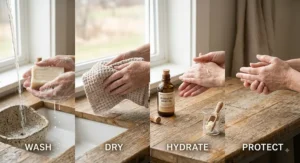
Buying the right bar only gets you halfway there — how you use it determines whether your hands actually heal or just stay in the same holding pattern. Dermatologists consistently emphasize one timing rule above everything else: moisturizer needs to go on damp skin, not dry skin, because it works by sealing in water that’s already there rather than adding water from nothing. Wash with lukewarm (never hot) water, since heat strips oils faster than warmth alone justifies, then pat — don’t rub — hands dry with a clean towel, leaving them slightly damp.
From there, apply a thick hand cream within sixty seconds of drying, focusing extra product on the backs of your hands and knuckles, where skin is thinner and cracks first. A common first-month mistake is over-washing in response to visible dryness, which paradoxically makes things worse; instead, swap in your cream bar soap consistently and let the formula do its job over several days rather than scrubbing harder. At night, a heavier occlusive layer — think petroleum jelly or a dedicated overnight balm — under cotton gloves can meaningfully accelerate healing on genuinely cracked skin, since it traps moisture against skin for hours instead of minutes.
Real-World Scenarios: Matching the Right Bar to Your Life
Picture Priya, a labor and delivery nurse washing her hands upward of forty times a shift between patients and the required alcohol rub in between. For her, a soap-free option like Cetaphil Gentle Cleansing Bar or CeraVe Hydrating Cleansing Bar makes the most sense — she needs something that won’t compound the drying effect of the sanitizer she’s already required to use constantly, and both bars are widely stocked enough that she’s never stuck without a replacement mid-week.
Now picture Marcus, a home cook whose hands are constantly wet from dishwashing and food prep, with rough, slightly cracked knuckles by Friday every week. Palmer’s Cocoa Butter Formula Cream Soap fits his situation well — he doesn’t have diagnosed eczema, just heavy mechanical wear, and the richer cocoa butter lather gives noticeably more repair than a clinical syndet bar would for his specific wear-and-tear pattern.
Finally, consider Elena, managing a toddler’s eczema alongside her own sensitive skin, trying to find one bar the whole household can share safely. Vanicream Cleansing Bar‘s fragrance-free, dye-free formulation and National Eczema Association Seal make it the obvious pick — it’s gentle enough for a child’s reactive skin while still being effective enough for her own daily use, cutting her bathroom’s product count down to one reliable bar instead of three specialized ones.
From Cracked Knuckles to Ragged Cuticles: A Problem-Solution Guide
Problem: visible cracks across the knuckles. These form when skin loses flexibility faster than it can regenerate, usually from a combination of hot water, harsh soap, and cold air. Switch to a soap-free cream bar like CeraVe Hydrating Cleansing Bar, apply a thick occlusive balm immediately after washing, and consider wearing cotton gloves overnight until the skin closes back up.
Problem: hands that sting immediately after washing. Stinging right at the sink is a strong sign your current bar’s pH or fragrance load is too aggressive for your skin’s current state. Fragrance-free syndet bars like Vanicream Cleansing Bar sidestep both issues at once, and most reviewers report the sting disappears within days of switching.
Problem: cuticle care gets forgotten entirely. Most dry-hand routines focus on palms and knuckles while ignoring the thin, delicate skin around nails, which cracks and peels just as easily. After washing with a cream bar soap, massage a small amount of cuticle oil or the excess residue from your hand cream directly into each nail bed — this is one of the simplest wins in this entire guide and takes under thirty seconds per hand.
Problem: dryness that flares specifically after using hand sanitizer. Alcohol-based sanitizers are necessary in many situations, but they compound whatever damage your soap is already doing. Pair a richer bar like Palmer’s Cocoa Butter Formula Cream Soap for your actual washes with a sanitizer that lists glycerin or aloe among its ingredients, and moisturize immediately after any sanitizer application rather than waiting until your next full wash.
✨ Ready to Rebuild Your Hand-Care Routine?
🔍 Pair any bar above with a thick, fragrance-free hand cream applied right after washing. Small habit changes compound fast — most people notice a real difference within a week of consistent use.
What Is Cream Bar Soap for Extremely Dry Hands?
Cream bar soap for extremely dry hands is a solid cleansing bar formulated with added emollients — glycerin, ceramides, shea or cocoa butter, or similar fat-based ingredients — blended directly into the cleansing base rather than relying on a standard detergent formula alone. Unlike ordinary bar soap, which is designed primarily to strip oil and dirt, a cream bar is engineered to cleanse while simultaneously replacing some of the lipids that washing removes, making it a meaningfully different product category rather than just a marketing label.
The distinction matters because standard bar soap typically runs at a higher, more alkaline pH than skin’s natural range, disrupting the acid mantle that keeps moisture locked in and bacteria out. Cream bars — particularly soap-free syndet versions — sit closer to skin’s own pH and actively deposit conditioning agents during the wash cycle, which is precisely why dermatologists reach for this category so often when recommending soap for cracked hands specifically.
How to Choose a Cream Bar Soap for Cracked Hands
- Check for “soap-free” or “syndet” on the label. These formulas skip the harsh alkaline chemistry of true soap, which matters most once skin is already cracked or actively irritated.
- Scan for fragrance if your skin reacts easily. Fragrance is one of the most common triggers for contact irritation, so fragrance-free is the safer default for genuinely reactive or eczema-prone hands.
- Look for a named active moisturizer, not just “moisturizing” on the front label. Ceramides, hyaluronic acid, glycerin, shea butter, and cocoa butter are all verifiable ingredients — vague marketing claims without a named ingredient are a red flag.
- Consider your actual wash frequency. Healthcare workers, food-service staff, and parents of young kids wash dramatically more than average, and need a bar engineered specifically for high-frequency use rather than an occasional-use luxury bar.
- Watch for a dermatology-backed credential. The National Eczema Association’s Seal of Acceptance requires real clinical irritation testing, making it one of the few third-party signals worth trusting on a label.
- Match richness to severity. Mild seasonal dryness responds well to lighter cream bars, while genuinely cracked or bleeding skin usually needs the richer, butter-forward formulas discussed in the problem-solution section above.
- Price per bar, not per pack. A cheaper multi-pack sometimes costs more per wash than a pricier single bar if the formula dissolves faster — worth doing the quick math before assuming budget options save money long-term.
Cream Bar Soap vs Liquid Hand Soap for Dry Skin
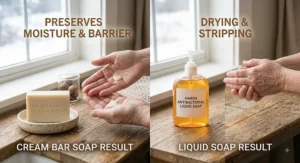
The bar-versus-liquid debate isn’t just about preference — the delivery format genuinely changes how ingredients interact with skin. Cream bars concentrate their emollients into a solid matrix that releases gradually as it lathers, while liquid soaps typically rely on a thinner, more diluted base that rinses away faster.
| Factor | Cream Bar Soap | Liquid Hand Soap |
|---|---|---|
| Moisturizer concentration | Higher, embedded in solid base | Often lower, diluted in water base |
| Cost per wash | Generally lower over time | Higher due to pump waste and dilution |
| Contamination risk | Minimal with proper drainage | Pump nozzles can harbor bacteria if unused |
| Best For | Vanicream, CeraVe, or Cetaphil for daily dry-skin management | Quick, low-maintenance use in shared or public spaces |
Reading the table above, cream bars generally win on pure moisturizing power because the emollients aren’t pre-diluted the way they are in a liquid formula — every lather delivers a more concentrated dose. That said, liquid soap still has a place in genuinely high-traffic public settings where a shared bar isn’t practical, and neither format has a meaningful edge over the other for actual germ removal, so the choice really comes down to which one your skin tolerates better long-term.
Cream Bar Soap for Healthcare Workers: Special Considerations
Healthcare workers occupy a uniquely brutal position in the dry-hands conversation: hand hygiene isn’t optional, it’s mandated dozens of times per shift, layered on top of glove-wearing and alcohol-based rubs between nearly every patient contact. A 2023 clinical review found that healthcare workers show a meaningfully higher prevalence of occupational contact dermatitis than the general population, driven largely by the combination of frequent hand sanitation and extended glove use — meaning the job itself, not any individual mistake, is the root cause.
That reality changes what a healthcare worker hand soap actually needs to accomplish. It has to clean thoroughly enough to meet infection-control standards while doing the least possible additional damage to skin that’s already being hit by sanitizer between every single wash. Soap-free options like Cetaphil Gentle Cleansing Bar and CeraVe Hydrating Cleansing Bar tend to perform best in this specific context, since their lower pH and barrier-supporting ingredients partially offset the cumulative stripping effect of a shift’s worth of hand hygiene. Facility-level research backs this up: a workplace quality-improvement study published in Frontiers in Public Health found that swapping in gentler hand hygiene products and trimming unnecessary hand hygiene steps, where clinically appropriate, meaningfully helped healthcare staff recover from irritant hand dermatitis during high-demand periods.
Occupational Dermatitis & Hand Sanitizer Overuse: Why Modern Hands Suffer
Occupational Dermatitis: The Clinical Picture
Occupational dermatitis is skin inflammation directly caused or worsened by workplace exposures, and hands bear the overwhelming majority of the burden since they’re the primary point of contact with irritants all day. A peer-reviewed review of occupational hand dermatitis in the National Library of Medicine’s PubMed database identifies irritant contact dermatitis from wet work as the single most common cause of occupational hand dermatitis, noting that healthcare workers, hairdressers, and metal workers face particularly elevated risk. “Wet work” simply means repeated exposure to water, detergents, and cleaning agents — exactly the pattern anyone chasing relentless dryness is probably living out every single day, whether or not their job title officially involves healthcare.
The distinction between occupational and non-occupational dermatitis usually comes down to timing: symptoms that reliably improve on days off and flare again once work resumes point strongly toward a workplace trigger. If that pattern sounds familiar, switching your primary hand-washing bar to a genuinely moisturizing formula is one of the few interventions within an individual’s direct control, even when the underlying wet-work exposure itself can’t be eliminated.
Hand Sanitizer Overuse: What the Alcohol Does to Your Skin
Hand sanitizer overuse is a real and measurable contributor to dry, cracked hands, distinct from — but often compounding — whatever soap you’re using. Alcohol at the concentrations required for effective disinfection is inherently dehydrating, stripping surface lipids with every application, and the more frequently it’s used, the less time skin has to recover between hits. According to CDC guidance on hand sanitizer use, sanitizer should be reserved for situations where soap and water genuinely aren’t available, not used as a default replacement for washing — a distinction that gets lost in a lot of everyday habits.
The fix isn’t abandoning sanitizer altogether; it’s being deliberate about when you reach for it, choosing formulas that include glycerin or aloe when possible, and treating every sanitizer application as a moment that also calls for moisturizer afterward, not just every full hand wash.
Common Mistakes When Buying Cream Bar Soap for Dry Hands
The most common mistake is trusting front-of-package claims over the actual ingredient list — “moisturizing” on the label means nothing without a named active ingredient backing it up, and plenty of bars marketed toward dry skin still lead with harsh sulfates further down the list. A close second is ignoring fragrance entirely, especially for anyone with a history of sensitive or reactive skin; a soap can be rich in butters and still cause more irritation than it solves if fragrance compounds are triggering a low-grade reaction nobody’s connected to the soap itself.
Buyers also frequently underestimate how much wash frequency should influence their choice, grabbing an occasional-use luxury bar for a job that demands forty washes a day, or vice versa — overpaying for a heavy-duty formula when their actual usage is light. Finally, many people give up on a new bar within a few days because dryness doesn’t reverse overnight; skin barrier repair genuinely takes one to two weeks of consistent use before the improvement becomes obvious, and switching products too quickly resets that clock every time.
Long-Term Cost & Maintenance: Is a Cream Bar Worth It?
| Product | Approx. Cost Per Bar | Approx. Washes Per Bar* | Approx. Cost Per Wash |
|---|---|---|---|
| Dove Sensitive Skin Beauty Bar | $1.50-$2.50 | ~40-50 | Under $0.05 |
| Palmer’s Cocoa Butter Cream Soap | $5-$9 | ~50-60 | ~$0.10-$0.15 |
| CeraVe Hydrating Cleansing Bar | $2-$3.50 | ~35-45 | ~$0.06-$0.09 |
*Estimates based on typical bar weight and average lather usage; individual results vary with wash habits.
Looking at the numbers, even premium ceramide bars like CeraVe Hydrating Cleansing Bar cost only a few cents more per wash than budget syndet bars once you spread the price across the bar’s full lifespan. The real cost consideration isn’t the soap at all — it’s what happens if you keep using an irritating formula and end up needing dermatology visits, prescription creams, or lost productivity from painfully cracked hands. Viewed as prevention rather than a cosmetic purchase, the incremental cost of a genuinely moisturizing cream bar soap is close to negligible.
Frequently Asked Questions
❓ What's the difference between cream bar soap and regular bar soap?
❓ Can cream bar soap actually heal cracked hands?
❓ Is bar soap or liquid soap better for extremely dry hands?
❓ How often should healthcare workers moisturize between hand washes?
❓ Does hand sanitizer make dryness worse than soap does?
Conclusion
Extremely dry hands rarely have one single cause, but the soap sitting at your sink is almost always part of the equation — for better or worse. Whether you land on the clinical minimalism of Vanicream Cleansing Bar, the ceramide-forward repair approach of CeraVe Hydrating Cleansing Bar, or the rich, buttery comfort of Palmer’s Cocoa Butter Formula Cream Soap, the underlying principle stays the same: a genuine cream bar soap for extremely dry hands cleans without stripping, and that single shift changes everything downstream, from how much lotion you need to how quickly cracked knuckles actually close up.
Give whichever bar you choose at least one to two full weeks before judging results, pair it with damp-skin moisturizing and the habit changes covered above, and don’t be afraid to match different bars to different needs across your household — a healthcare worker, a home cook, and a toddler with eczema rarely need the exact same formula, even under one roof.
✨ Found This Guide Helpful? Share It With Someone Whose Hands Need It Too! 💬🤗
Recommended for You
- Shea Butter Bar Soap for Dry Winter Skin: 7 Picks That Work (2026)
- 7 Best Hypoallergenic Bar Soap for Tattoo Aftercare Picks (2026)
- 7 Best Gentle Bar Soap for Eczema Picks That Won’t Backfire (2026)
Disclaimer: This article contains affiliate links. As an Amazon Associate, I earn from qualifying purchases. If you purchase products through these links, we may earn a small commission at no additional cost to you.
✨ Found this helpful? Share it with your friends! 💬🤗
