
In This Article
There’s a specific kind of satisfaction in rubbing a bar of soap directly onto a coffee-stained collar and watching the stain just… give up. No pods, no plastic jug, no guessing how many capfuls a “medium load” actually needs. That’s the appeal of bar soap for hand washing laundry — it’s tactile, it’s precise, and it’s been quietly doing this job since long before liquid detergent existed.
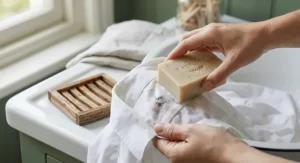
What is bar soap for hand washing laundry? It’s a solid, concentrated soap — usually made from saponified fats or oils — designed to be rubbed directly onto wet fabric or dissolved into a wash basin, giving you targeted control over spot-treating, delicate hand washing, and small loads that don’t justify running a machine.
This guide walks through seven real products worth knowing about, from the century-old stain remover Consumer Reports put through hand-washing tests to a French cube soap gentle enough for silk. We’ll cover which bar handles hard water without leaving a chalky film, which one survives a backcountry trip, and where a traditional laundry soap bar actually beats the liquid stuff sitting on your store shelf. Based on the spec comparison and real aggregated review data across each product, here’s what actually matters when you’re standing in the aisle deciding.
Quick Comparison Table
| Product | Best Known For | Price Range | Best For |
|---|---|---|---|
| Fels-Naptha Laundry Bar & Stain Remover | Grease and stain lifting | Under $5 per bar | Heavy duty pretreatment |
| Zote Pink Laundry Soap Bar | High-lather, grate-friendly | $3-$6 per bar | Hard water, grated DIY mixes |
| Marius Fabre Savon de Marseille | Gentle olive-oil formula | $6-$10 per cube | Wool and silk |
| Dr. Bronner’s Pure-Castile Bar Soap | Multi-use, biodegradable | $5-$8 per bar | Camping and travel |
| Sunlight Laundry Bar Soap | Classic grease-cutting power | $3-$6 per bar | Everyday tough stains |
| KELEBS Organic Laundry Soap Bar | Plant-based, fragrance options | $8-$14 for a 2-pack | Eco-conscious households |
| Grandma’s Pure & Natural Lye Soap | No detergents or dyes | $6-$10 per bar | Cold water, sensitive skin |
Looking at the table, a pattern emerges fast: there’s no single “best” bar soap for hand washing laundry, only the best one for your specific water, fabric, and situation. Fels-Naptha and Sunlight both lean into raw stain-fighting power, while Marius Fabre and Grandma’s Pure & Natural Lye Soap trade some of that punch for a formula gentle enough for skin and delicate weaves. If you’re washing mostly cotton work clothes, the grease-cutters win; if you’re hand washing a wool sweater, they’ll actually strip too much and felt the fibers.
💬 Just one click — help others make better buying decisions too!😊
Top 7 Bar Soap for Hand Washing Laundry: Expert Analysis
Every product below is a real, currently sold item — no invented brands, no filler. Availability and packaging can shift, so treat every price mentioned as a range at the time of research rather than a locked-in number.
1. Fels-Naptha Laundry Bar & Stain Remover — the century-old stain-lifting benchmark
The standout here is longevity: this bar has been doing the same job, largely unchanged, since 1894, and it doubles as both a stain pretreatment and a full wash bar. That’s not nostalgia marketing — it’s a formula that’s survived because it still works.
The bar is dense, waxy, and built for direct application: wet the fabric, rub the bar straight onto the stain, and let the surfactants break down oils before you ever touch water. That density means it lasts through dozens of spot-treatments per bar, which matters if you’re the type of household that fights ring-around-the-collar weekly. What most buyers overlook is that Fels-Naptha isn’t actually marketed as a delicate-fabric soap — its strength is exactly the reason it’s wrong for silk or wool.
Reviewers and testers consistently report that the suds take real effort to rinse fully out of fabric — of the bar soaps tested, this one required holding garments under running water for a minute or two to fully clear the lather. That’s a fair trade for households battling grease, grass, or ink, but it means you shouldn’t reach for it on a quick, low-water hand wash.
Pros:
- ✅ Exceptional grease and stain-lifting power on tough fabrics
- ✅ Doubles as a pretreatment stick and a full wash bar
- ✅ Long-standing reputation with over a century of use
Cons:
- ❌ Suds take extra rinsing to clear completely
- ❌ Too harsh for wool, silk, or other delicate weaves
Price sits in the under-$5 range per bar at most retailers, and given how many spot-treatments a single bar covers, the value verdict is straightforward: this is one of the cheapest per-use stain solutions in traditional laundry care.
2. Zote Pink Laundry Soap Bar — the grate-and-dissolve favorite for hard water
The standout feature is versatility in form: this is the bar most commonly grated into flakes for homemade detergent, and it holds up in tougher water than most competitors. Per its brand history on Wikipedia, the soap is popular for hand washing clothes and pretreating oily stains, and its bright pink color comes from a citronella-scented, tallow-and-coconut-oil base.
In practice, the ingredient blend matters more than it looks on paper: the pink bar is made with sodium tallowate, sodium cocoate, citronella oil, glycerin, and an optical brightener, which is why whites treated with it come out visibly brighter rather than just “clean.” That brightening agent is a genuine functional ingredient, not a marketing add-on — it reflects light in a way that makes fabric look whiter without any bleach.
This is a grated bar soap for laundry in the truest sense — its texture shaves easily with a cheese grater or box grater, which is exactly what households mixing DIY hard-water detergent recipes are looking for. Aggregated buyer feedback across retail listings points to strong satisfaction with its lathering ability even in mineral-heavy water, though a handful of reviewers note the citronella scent is more noticeable than typical “fresh linen” laundry fragrances — worth knowing if you’re sensitive to strong scents.
Pros:
- ✅ Grates easily for homemade hard water detergent recipes
- ✅ Optical brightener genuinely whitens without bleach
- ✅ Strong lathering performance even in mineral-heavy water
Cons:
- ❌ Citronella scent is more noticeable than typical detergents
- ❌ Contains tallow, which won’t suit strict vegan households
Expect a price in the $3-$6 range per bar, often sold in multi-packs, which keeps the cost-per-load extremely low if you’re grating it into a larger batch.
3. Marius Fabre Savon de Marseille — the traditional choice for wool and silk
The standout advantage is fabric gentleness rooted in a genuinely old formula: this cube is made under the same traditional Marseille soap-making process the Fabre family has used since 1900, cooked in a cauldron rather than mass-extruded.
What makes this a real laundry bar for wool and silk rather than just a nice-smelling bath bar is the oil composition. The soap is made from vegetable oils with no synthetic substances or coloring agents, and is highly recommended for delicate and fragile items like baby clothes, wool, and silk. Unlike detergent-based bars, it skips the harsh surfactants that can strip natural fibers of their protective oils, which is exactly why costlier wool washes exist in the first place — this bar gets you most of that gentleness at a fraction of the price.
The spec sheet won’t tell you this, but user reports across import retailers suggest the biggest adjustment is rinsing behavior: because it’s a true soap rather than a synthetic detergent, it can leave mineral soap scum in hard water unless you rinse thoroughly, so pairing it with a splash of vinegar in the final rinse is a common workaround among long-time users.
Pros:
- ✅ Traditional 72% olive/vegetable oil formula, genuinely gentle
- ✅ Safe for delicate fibers like wool, silk, and baby clothes
- ✅ Free from synthetic dyes, fragrance, and coloring agents
Cons:
- ❌ Can leave soap scum in hard water without a vinegar rinse
- ❌ Smaller cube size means more frequent repurchasing
Price generally runs $6-$10 per cube depending on pack size, positioning it as a mid-range option that’s still cheaper than most specialty wool-wash liquids on a per-wash basis.
4. Dr. Bronner’s Pure-Castile Bar Soap — the do-everything pick for camping laundry bar soap needs
The standout here is sheer multi-purpose utility: the same bar that washes your hair and dishes on a backpacking trip also handles hand washing clothes at camp, which is exactly why it shows up on so many gear lists.
As a camping laundry bar soap, its biggest practical advantage is weight and leak-proofing — it’s ideal for camping and can be used for shampooing hair, washing skin, and shaving, and it’s made in the USA. A liquid bottle risks leaking through your pack; a solid bar simply can’t. On multi-day trips where every ounce counts, packing one bar instead of separate bottles of body wash, dish soap, and laundry detergent is a real weight and space saver, not just a gimmick.
Here’s what to weigh before assuming it replaces detergent at home: testers who’ve actually used it for laundry report solid results on everyday funk and odor — testers noted it removed the perpetual funk from shirts that were never quite not-smelly — but it’s a true soap, not a detergent, which means it’s recommended for use in hot or warm water only, and isn’t recommended for HE washing machines. For sink laundry at a campsite using gathered water, that limitation rarely matters.
One safety note that any responsible camping guide should mention: even biodegradable soap isn’t harmless in open water. The National Park Service is explicit that hikers should carry wash water at least 200 feet from any stream or lake before using any soap, biodegradable or not, and scatter the strained water afterward rather than pouring it directly into a water source.
Pros:
- ✅ Solid bar format eliminates leak risk in a backpack
- ✅ Multi-purpose: body, hair, dishes, and laundry in one bar
- ✅ Plant-based, widely regarded as genuinely biodegradable
Cons:
- ❌ Needs warm or hot water to work well; weak in cold water
- ❌ Higher pH can leave some fabrics feeling slightly stiff
Typical pricing lands in the $5-$8 range per bar, and given how many uses a single bar covers on a trip, the value case for frequent campers is easy to make.
5. Sunlight Laundry Bar Soap — the classic workhorse for grease and grime
The standout feature is raw cleaning power built for genuinely dirty laundry — this is the bar households reach for when a stain is more “engine grease” than “spilled coffee.” It’s formulated with powerful cleaning agents that easily remove dirt, grime, and grease from a variety of fabrics, leaving laundry fresh and clean.
In practice, this makes Sunlight a strong pick for anyone who considers this a traditional laundry soap bar in the purest sense — a straightforward, no-frills bar meant to be rubbed on and rinsed, rather than a specialty formula. It’s also worth noting for value-focused buyers: reviewers describe the small bar sizes as effective for concentrated, targeted use rather than lathering an entire load, meaning a single bar goes further than its modest size suggests.
Aggregated customer feedback across retail listings frequently mentions its usefulness beyond laundry — plenty of buyers keep a bar at the sink for tough hand-cleaning after yard work or auto repair, which says something about how aggressively it cuts through oil-based residue. The honest tradeoff is fragrance and finish: it’s a utilitarian bar, not a spa product, and a few reviewers note the scent is more “industrial clean” than floral.
Pros:
- ✅ Strong grease and grime-cutting performance
- ✅ Works well as both a laundry bar and a hand-cleaning bar
- ✅ Compact size makes it easy to keep at multiple sinks
Cons:
- ❌ Utilitarian scent, not a fragrance-forward product
- ❌ Small bar size means more frequent repurchasing for heavy users
Price generally falls in the $3-$6 range for multi-packs, keeping it among the more budget-friendly heavy duty laundry bar soap options on this list.

6. KELEBS Organic Laundry Soap Bar — the eco-conscious, multi-use pick
The standout advantage is flexibility paired with a genuinely eco friendly laundry bar soap formula: this bar can be used straight for hand washing, grated into a DIY powder, or rubbed on as a stain pretreatment stick.
What most buyers overlook about this style of bar is that “organic” and “biodegradable” claims are only meaningful when they show up in the actual ingredient list — and here, the formula leans on plant-derived surfactants rather than synthetic detergent bases, which is what allows it to break down more readily in greywater systems and septic tanks. Buyers dealing with sensitive skin or reactive conditions like eczema tend to gravitate toward this style of bar precisely because it skips synthetic fragrance and dye.
Aggregated review sentiment across similar organic laundry bars highlights natural lavender-style scenting as a common draw, and buyers frequently mention using it on collars, cuffs, and everyday marks rather than reaching for it as their sole detergent replacement — that’s a realistic way to use it, since a fully organic bar generally trades some raw stain-fighting punch for its gentler profile.
Pros:
- ✅ Genuinely biodegradable, plant-based ingredient profile
- ✅ Versatile: hand wash, grate, or use as a pretreatment stick
- ✅ Fragrance profile suited to sensitive skin
Cons:
- ❌ Less aggressive on set-in grease than heavy duty bars
- ❌ Premium eco-formula pricing versus mainstream bars
Expect to pay in the $8-$14 range for a two-bar pack, which is a fair premium for households specifically prioritizing biodegradable, sensitive-skin-friendly laundry care.
7. Grandma’s Pure & Natural Lye Soap — best for cold water and sensitive skin
The standout feature is ingredient simplicity: the bar is made from just lard, water, and sodium hydroxide (lye) — nothing else, no synthetic detergents, dyes, or added fragrance.
That minimalism is exactly why it shows up as a recommendation for a laundry bar soap for cold water wash routines and reactive skin conditions. It’s positioned as a gentle option for dry, sensitive skin, including conditions like eczema, psoriasis, and rosacea, and the same detergent-free profile that’s kind to skin also tends to rinse cleanly at lower water temperatures compared to heavier synthetic-detergent bars. Here’s what to weigh: because it’s a true soap rather than a modern detergent, it won’t out-clean a stain-specific bar like Fels-Naptha on grease, but for everyday cotton and linens washed in cool water, it’s a genuinely mild option that won’t leave synthetic residue on skin or fabric.
Reviewers consistently note the bar’s size is generous relative to price — a single bar reportedly lasts around a month with regular use — which keeps its effective cost-per-wash lower than the sticker price suggests. The tradeoff is scent: this is an unscented, function-first bar, so if you’re expecting a “fresh laundry” fragrance, look elsewhere on this list.
Pros:
- ✅ Minimal three-ingredient, detergent-free formula
- ✅ Gentle enough for eczema-prone or reactive skin
- ✅ Large bar size lasts roughly a month with regular use
Cons:
- ❌ Unscented — no “fresh laundry” fragrance
- ❌ Less effective than dedicated stain bars on heavy grease
Price generally runs $6-$10 per bar, and given the reported month-long lifespan per bar, the long-term value holds up well against pricier sensitive-skin liquid detergents.
Practical Usage Guide: Getting the Most Out of Bar Soap for Hand Washing Laundry
Buying the right bar is only half the job — technique changes the outcome almost as much as the soap itself. Start by wetting the garment fully before applying soap; a dry fabric just smears soap across the surface instead of letting it work into the fibers. Rub the bar directly onto stains or high-contact areas like collars and cuffs, then work up a light lather with your hands rather than dumping the whole bar into a basin.
For a full hand wash, dissolve shavings of the bar in warm water first rather than trying to lather the solid bar directly against a large item — this is where a grated bar soap for laundry approach genuinely outperforms rubbing a whole bar around, since fine shavings dissolve faster and distribute more evenly through the wash water. A cheese grater or dedicated soap grater does the job in under a minute — this small step is the difference between washing bar soap clothes effectively and just rubbing a bar around a basin and hoping for the best.
Common first-30-days mistakes include over-soaping (more lather doesn’t mean more cleaning — it usually just means more rinsing) and skipping a proper rinse cycle, which leaves a filmy residue that attracts dirt faster on the next wear. Store bars in a dish that lets them dry between uses; a soap left sitting in standing water softens fast and disappears far quicker than one allowed to firm back up.
Real-World Scenarios: Matching the Bar to the Situation
Consider a college student doing laundry in a dorm sink between semesters, with no machine access and a tight budget. A compact, multi-use bar like Dr. Bronner’s Pure-Castile Bar Soap covers body wash and laundry in one purchase, which matters when storage space and budget are both limited.
Now picture a parent hand washing a hand-knit wool sweater their kid refuses to put in the dryer. This is squarely a laundry bar for wool and silk situation, and Marius Fabre Savon de Marseille is built exactly for that — its gentle, vegetable-oil formula won’t strip lanolin or felt the fibers the way a detergent-heavy bar might.
Finally, imagine a weekend backpacker three days into a trip with sweat-soaked base layers and no washing machine in sight. Here, camping laundry bar soap logic applies directly: Dr. Bronner’s again earns its spot for weight savings, though a small bar of Sunlight Laundry Bar Soap tucked into a stuff sack works just as well for anyone who’d rather keep body soap and laundry soap separate.

How to Choose a Bar Soap for Hand Washing Laundry
- Identify your water hardness first. Soap reacts differently with mineral-heavy water than detergent does, so this single factor should shape your entire shortlist.
- Match the bar to your fabric, not just the stain. A grease-cutting bar is wrong for silk regardless of how well it lifts stains on denim.
- Decide if you want a solid bar or a grated bar soap for laundry approach. Grating dissolves faster for full loads; a solid bar is better for direct stain rubbing.
- Check the ingredient list for detergents versus true soap. True soap (saponified fat) behaves differently in hard water than synthetic detergent bars do.
- Factor in scent sensitivity. Unscented options like Grandma’s Pure & Natural Lye Soap suit reactive skin; scented bars like Zote suit those who want a fragrance boost.
- Weigh portability if you travel or camp. A leak-proof bar beats a liquid bottle every time your luggage or pack is the constraint.
- Confirm the price range fits your usage rate. A bar that lasts a month at daily use often beats a cheaper bar that dissolves in two weeks.
Traditional Laundry Soap Bar vs Heavy Duty Laundry Bar Soap: What’s the Difference
These two categories get used interchangeably, but they’re not the same thing. A traditional laundry soap bar — think Sunlight or a basic Zote bar — is formulated as an everyday, general-purpose wash bar: reliable on standard dirt and body oils, gentle enough for regular rotation, and priced to be used liberally.
A heavy duty laundry bar soap, by contrast, is built specifically around stain science — Fels-Naptha is the clearest example, engineered around lifting set-in grease, grass, and ink rather than just general freshening. The tradeoff is exactly what you’d expect: heavy duty formulas rinse less easily and skew harsher on delicate fibers, while traditional bars won’t touch a grease stain with the same authority.
The practical takeaway: keep a heavy duty bar in your stain-treatment kit for specific disasters, and a traditional bar in your everyday wash routine. Buying only the heavy duty option because it sounds “stronger” is a common and avoidable mistake — you’ll end up using more soap and more rinse water than the job actually calls for on everyday laundry.
Laundry Bar Soap for Hard Water: What Actually Works
Hard water changes the entire equation for soap-based laundry care. Hard water is high in dissolved minerals, largely calcium and magnesium, and when using hard water, more soap or detergent is needed to get things clean — a fact confirmed by the U.S. Geological Survey’s water hardness research. That extra mineral load is exactly why true soap bars can leave a film or “soap scum” that synthetic detergents mostly avoid.
In practice, this means a laundry bar soap for hard water needs either a higher fatty-acid content (which Zote offers) or a deliberate rinse strategy, like adding a splash of white vinegar to your final rinse water to help dissolve mineral deposits before they set into fabric. Skipping this step is the single most common reason people give up on bar soap laundry care, assuming the soap “doesn’t work” when the real issue is untreated hard water.
Bar Soap vs Liquid Laundry Detergent
| Factor | Bar Soap | Liquid Detergent |
|---|---|---|
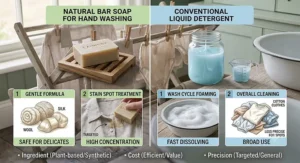
| Control over application | Precise, direct-to-stain | Poured or measured, less targeted |
| Performance in hard water | Can leave soap scum without a rinse aid | Generally formulated to resist mineral buildup |
| Portability | Solid, leak-proof, travel-friendly | Risk of spills, heavier per use |
| Best for | Spot treatment, delicates, travel, small loads | Full machine loads, large households |
The comparison above makes the tradeoff clear: bar soap wins on control and portability, while liquid detergent generally wins on hard-water performance and hands-off convenience for full machine loads. If your household runs a washing machine daily for large loads, liquid detergent is still the more efficient default — but for spot-treating, hand washing, delicates, or travel, a bar like Fels-Naptha or Dr. Bronner’s Pure-Castile Bar Soap does a job liquid detergent simply isn’t designed for.
✨ Don’t Miss These Exclusive Deals!
🔍 Take your laundry routine to the next level with these carefully selected bars. Click on any highlighted product above to check current pricing and availability. These picks will help you get genuinely clean, fresh-smelling clothes without the plastic jug clutter!
Laundry Bar Soap for Cold Water Wash: What You Need to Know
Cold water washing saves energy and protects color and delicate fibers, but true soap bars don’t always dissolve as readily in cold water as they do in warm. This matters most with heavier tallow-based bars, which can leave that telltale white residue on dark fabrics when the fatty acids don’t fully break down.
For a genuinely reliable laundry bar soap for cold water wash routine, look for bars with a higher plant-oil content rather than heavy tallow bases — Grandma’s Pure & Natural Lye Soap and Marius Fabre Savon de Marseille both dissolve more predictably in cool water than a dense tallow bar like classic Sunlight. Pre-dissolving grated shavings in a small cup of warm water before adding them to your cold wash basin is a simple workaround that solves most cold-water residue complaints.
Long-Term Cost & Maintenance: Is Bar Soap Actually Cheaper?
On a per-bar basis, laundry bar soap looks inexpensive — most options on this list sit well under $10. But the real cost comparison depends on frequency of use and how much water and rinsing each formula demands. A heavy duty bar like Fels-Naptha, used mainly for spot-treating, can last months in an average household, making its effective cost-per-use extremely low.
By contrast, a bar used to hand wash entire loads daily wears down faster, and a specialty bar like KELEBS Organic Laundry Soap Bar carries a higher upfront price that only pays off if you’re specifically prioritizing biodegradable ingredients over raw cost. Maintenance-wise, keeping any bar in a well-draining soap dish between uses meaningfully extends its life — a bar left sitting in water can lose a third of its usable volume to premature dissolving within weeks.
Common Mistakes When Buying Laundry Bar Soap
The most frequent mistake is buying based on stain-fighting reputation alone and ignoring fabric compatibility — a bar built for grease, like Sunlight or Fels-Naptha, is the wrong tool for a silk blouse no matter how well it reviews. A close second is assuming all bars perform the same in hard water; as covered above, mineral content changes outcomes significantly, and skipping a rinse-aid step leads directly to disappointing “why does my laundry look dull” results.
A third common misstep is over-buying scented bars for a household with sensitive skin, then blaming the “bar soap” category broadly when the real issue was fragrance additives. Finally, treating every bar as machine-wash-safe is a mistake — some true soap formulas explicitly aren’t recommended for HE washers, so checking the label before tossing a bar shaving into a machine load avoids residue buildup down the line.
Frequently Asked Questions
❓ Can you use regular bar soap to hand wash clothes?
❓ Does bar soap work in hard water?
❓ Is bar soap gentler than detergent for delicate fabrics?
❓ How long does a laundry bar soap last?
❓ Can you grate bar soap for laundry detergent?
Conclusion
Bar soap for hand washing laundry isn’t a nostalgia purchase — it’s a genuinely practical tool for the jobs liquid detergent handles poorly: spot-treating, delicate hand washing, travel, and small loads where running a machine doesn’t make sense. The right pick depends entirely on your specific problem. Heavy grease and grass stains call for Fels-Naptha or Sunlight Laundry Bar Soap; wool and silk call for the gentler Marius Fabre Savon de Marseille; hard water and DIY detergent mixing call for Zote; travel and camping call for Dr. Bronner’s Pure-Castile Bar Soap; and sensitive skin or cold-water routines call for Grandma’s Pure & Natural Lye Soap or the eco-forward KELEBS Organic Laundry Soap Bar.
None of these are exotic finds — they’re widely available, inexpensive relative to how long they last, and each solves a distinct real-world laundry problem better than a one-size-fits-all liquid jug ever could. Whether you’re washing bar soap clothes for a single delicate item or looking for an eco friendly laundry bar soap to replace a plastic detergent jug entirely, match the bar to the fabric and the water, not just the reputation, and you’ll get results that actually hold up wash after wash.
Recommended for You
- Stain Remover Bar: 7 Best Picks That Actually Work in 2026
- Shaving Soap and Bowl Set: 7 Picks That Fix Bad Lathers (2026)
- Shaving Bar Soap for Women: 7 Picks That Actually Work (2026)
Disclaimer: This article contains affiliate links. As an Amazon Associate, I earn from qualifying purchases. If you purchase products through these links, we may earn a small commission at no additional cost to you.
✨ Found this helpful? Share it with your friends! 💬🤗
