
In This Article
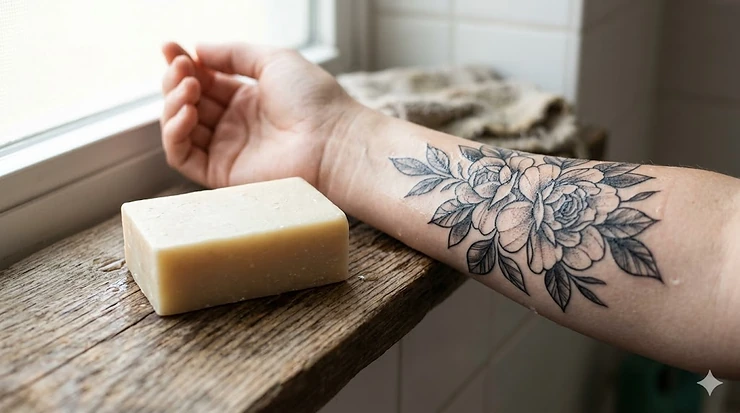
You just sat through hours of needlework. Your skin is raw, your new tattoo is wrapped, and the artist handed you an aftercare sheet. Somewhere on that sheet, probably underlined, are two words: gentle soap. Sounds simple. It isn’t.
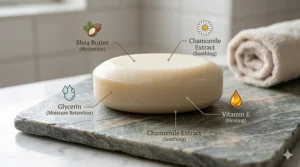
Walk into any pharmacy and you’ll face an entire wall of options — fragrant bars, foaming washes, “antibacterial” bottles promising to kill 99.9% of everything. Here’s the problem: most of them will do more harm than good on healing ink. Fragrances irritate. Harsh surfactants strip your skin’s natural barrier. Some “antibacterial” agents — triclosan, benzalkonium chloride — disrupt the very microbiome your skin needs to repair itself after being tattooed.
The bar soap aisle, specifically, has gone underrated in the tattoo aftercare conversation. Liquid pump soaps dominate the market and most recommendation lists. But a quality bar soap for tattoo aftercare — gentle, fragrance-free, pH-balanced — can be every bit as effective, travels easier, lasts longer, and often costs significantly less per wash. For people who take their ink seriously, it’s worth knowing which bars actually belong in your bathroom during those critical first few weeks.
What separates a good tattoo healing cleanser from a bad one isn’t the form factor. It’s the ingredient list. A fresh tattoo is, clinically speaking, an open wound. The American Academy of Dermatology recommends washing new tattoos with a gentle, fragrance-free cleanser — no loofahs, no scrubbing, no overwashing. That advice points directly to the kind of formulas we’re covering here.
After testing, researching customer feedback, and consulting ingredient lists with dermatology resources, I’ve narrowed down the 7 best bar soaps for tattoo aftercare available on Amazon right now. Whether you’ve got sensitive skin, a tight budget, or a fresh sleeve that needs hospital-grade gentleness, there’s a pick here for you.
Quick Comparison: Best Bar Soap for Tattoo Aftercare at a Glance
| Product | Best For | Key Feature | pH-Balanced | Price Range |
|---|---|---|---|---|
| Dr. Bronner’s Baby Unscented Bar | All-natural purists | Organic castile, zero synthetics | ✅ Yes | $5–$9 per bar |
| Dove Sensitive Skin Beauty Bar | Budget-conscious buyers | Mild, moisturizing, widely available | ✅ Yes | $1–$2 per bar (bulk) |
| Cetaphil Gentle Cleansing Bar | Sensitive & eczema-prone skin | Soap-free, dermatologist-formulated | ✅ Yes | $4–$6 per bar |
| CeraVe Hydrating Cleanser Bar | Dry skin, barrier repair | Ceramides + hyaluronic acid | ✅ Yes | $5–$8 per bar |
| Dial Gold Antibacterial Bar Soap | Budget + antibacterial combo | Benzalkonium chloride-based | ⚠️ Mild | $1–$2 per bar |
| Vanicream Cleansing Bar | Reactive / allergy-prone skin | Free of dyes, fragrance & parabens | ✅ Yes | $5–$7 per bar |
| Kirk’s Original Coco Castile Bar | Natural, eco-conscious buyers | Coconut oil base, biodegradable | ✅ Yes | $2–$4 per bar |
Prices are approximate ranges based on Amazon listings at time of research and may vary.
Looking at this table, a few things jump out immediately. The mid-range options — Cetaphil, CeraVe, Vanicream — cluster around a similar price point and all share the same core philosophy: soap-free or near-soap-free formulas that prioritize barrier protection. If you’re choosing purely on ingredient quality per dollar, Vanicream and Cetaphil are neck-and-neck. Budget buyers who want to spend as little as possible without compromising safety will find Dove punching well above its price tag, but Dial Gold warrants caution for anyone with reactive or fragrance-sensitive skin despite its “unscented” labeling.
💬 Just one click — help others make better buying decisions too! 😊
Top 7 Bar Soaps for Tattoo Aftercare: Expert Analysis
1. Dr. Bronner’s Pure-Castile Baby Unscented Magic Bar Soap — The Artist’s Old Faithful
If there’s one product that tattoo artists actually write on their aftercare sheets by name, it’s Dr. Bronner’s. The Baby Unscented variant — not the regular lavender or peppermint versions, those have essential oils that can irritate fresh skin — is a 5 oz castile bar made with Regenerative Organic Certified coconut, palm, and olive oils. No synthetic preservatives. No detergents. No foaming agents your skin didn’t ask for.
What does that mean in practice? When you wash a fresh tattoo with this bar, you’re cleaning without stripping. The saponified oils create a genuinely gentle lather that lifts plasma, excess ink, and environmental debris without destroying the lipid barrier your skin is desperately trying to rebuild. That’s the part most people don’t think about: your skin isn’t just healing the puncture wounds, it’s rebuilding its outer protective layer, and every harsh wash sets that process back.
This is the bar soap for tattoo aftercare I’d recommend first to nearly anyone who doesn’t have a specific skin condition requiring a more clinical formula. It works beautifully for normal-to-combination skin, it’s vegan, and the small bar size fits neatly in a gym bag for post-workout rinses. Artists love it because it’s reliable and honest — no marketing fluff, just effective, clean ingredients.
Customers consistently praise how their tattoos healed without excessive scabbing or dryness. A few note you only need a pea-sized amount — more than that and rinsing takes a while.
✅ Zero synthetic preservatives or foaming agents
✅ Regenerative Organic Certified oils
✅ Artist-endorsed for decades
❌ Higher pH than truly soap-free options — not ideal for very reactive skin
❌ Must be used sparingly or lather becomes excessive
Price: around $5–$9 per bar. Outstanding value for the ingredient quality delivered.
2. Dove Sensitive Skin Beauty Bar (Fragrance-Free) — The Budget MVP Nobody Argues With
Here’s a fact that surprises people: the Healthline guide to tattoo aftercare specifically names Dove Sensitive Skin Beauty Bar as one of the most artist-recommended options for fresh ink. And that makes complete sense once you understand what Dove actually is. Despite being called a “beauty bar,” it isn’t technically soap — it’s a syndet (synthetic detergent) bar, meaning it’s soap-free, extremely mild, and formulated to stay closer to your skin’s natural pH than traditional bar soaps.
The 3.75 oz fragrance-free version is what you want. Dove’s standard bars often contain fragrance; the sensitive skin line doesn’t, which matters enormously during the first two to three weeks of healing. The formula contains mild surfactants plus moisturizing cream (basically 1/4 moisturizer by their own description), which helps prevent the excessive dryness that leads to thick scabbing and color loss.
What most buyers overlook is that this bar is also incredibly forgiving if you accidentally over-wash. Because it’s so mild, twice-daily use won’t leave your tattoo feeling parched and tight the way a stronger antibacterial bar might. For first-timers who are anxious about their new ink and tempted to wash it five times a day — this is the training wheels bar that won’t punish you for caring too much.
Customers in the 8-bar multipack format rave about how gentle and non-drying it feels, with many specifically noting it was recommended by their dermatologists for eczema — which signals how safe it is for compromised or healing skin.
✅ Soap-free syndet formula — pH close to skin’s natural level
✅ Fragrance-free variety widely available
✅ Excellent value in bulk packs
❌ Contains some synthetic ingredients some natural-only buyers prefer to avoid
❌ Bar can get mushy if left sitting in water
Price range: around $1–$2 per bar in multipack formats. Basically unbeatable for what it delivers.
3. Cetaphil Gentle Cleansing Bar — The Dermatologist-Approved Workhorse
Cetaphil has spent decades building trust in dermatology offices, and this 4.5 oz cleansing bar is exactly why. It’s soap-free, hypoallergenic, non-comedogenic, and paraben-free — a checklist that reads like the exact requirements for a tattoo healing cleanser. The formula contains five nourishing ingredients specifically chosen for sensitive, dry skin, and it’s free of harsh surfactants that would otherwise strip protective oils.
The practical difference between Cetaphil’s bar and a traditional soap bar is this: traditional soaps have a high pH (around 9-10), which is bad news for a healing tattoo because it disrupts the skin’s acid mantle — the slightly acidic surface layer that acts as your first line of defense against bacteria. Cetaphil’s bar sits closer to skin-neutral pH, meaning each wash supports rather than fights your skin’s natural defenses. For someone with a large tattoo covering significant body surface area, this pH difference compounds over dozens of washes.
Where this bar really shines is for people with eczema, rosacea, or generally reactive skin who are worried about having a new tattoo. The Cetaphil bar is clinically predictable — it does exactly what it says, every time, without surprises. That predictability is worth a premium during the anxiety-inducing early healing phase.
Buyers frequently mention using it on advice from their dermatologist and being impressed by how clean it rinses without leaving residue. A 3-count pack makes the per-unit cost very reasonable for a clinical-grade formula.
✅ Soap-free, hypoallergenic, non-comedogenic
✅ 5 nourishing ingredients; zero harsh surfactants
✅ Dermatologist-tested for sensitive and dry skin
❌ Not the flashiest formula — no skin-repair actives like ceramides
❌ Can feel slightly waxy on rinsing for some skin types
Price range: around $4–$6 per bar in 3-count packs. Worth every penny for reactive skin.
4. CeraVe Hydrating Cleanser Bar — The Barrier-Repair Specialist
CeraVe is the brand that dermatology Twitter won’t stop talking about, and there’s good reason. Their Hydrating Cleanser Bar brings something genuinely different to the bar soap for tattoo aftercare conversation: ceramides. Ceramides are lipid molecules that are literally part of the structure of your skin’s barrier — the same barrier that gets compromised when you get tattooed. A soap that actively replenishes ceramides while cleansing is not just washing your tattoo; it’s participating in the repair process.
The 4.5 oz bar also contains hyaluronic acid, which draws moisture into the skin, and is free of fragrance, dyes, and parabens. It’s developed with dermatologists (CeraVe’s core brand proposition) and is classified soap-free — meaning that neutral pH advantage we discussed with Cetaphil applies here too.
The real-world difference between CeraVe and a basic gentle bar shows up in week two of healing, when your tattoo starts to peel and the skin can feel uncomfortably tight. Where other bars just clean and get out of the way, the CeraVe bar is actively helping rebuild what the needle disrupted. If your skin tends to feel pulled and dry after washing regardless of what soap you use, this bar is your answer.
Customers who use it as part of a CeraVe system (bar + moisturizing lotion) report some of the smoothest, least-scabby healing experiences you’ll read about online. The 2-pack format makes the per-bar price competitive.
✅ Ceramides + hyaluronic acid actively support barrier repair
✅ Soap-free, fragrance-free, dermatologist-developed
✅ Ideal for dry-to-normal skin types
❌ Pricier per bar than budget options
❌ May feel slightly more moisturizing than some prefer during early wet healing
Price range: around $5–$8 per bar. Premium choice that earns its cost for dry skin healers.
5. Dial Gold Antibacterial Bar Soap — The Classic with Caveats
Dial Gold is the rebel pick on this list — and I say that with respect for its long history. Many tattoo artists still recommend it, especially older-school shops, because it’s cheap, widely available at 3 AM when you realize you need soap for your fresh tat, and it does kill bacteria effectively with its triclosan-free, benzalkonium chloride-based formula.
Here’s what the spec sheet won’t tell you: the word “unscented” on Dial Gold doesn’t mean zero fragrance compounds. It means the product’s scent has been masked to be neutral — a distinction that matters for people with sensitive or reactive skin. And the surfactants are stronger than the soap-free options above, meaning more aggressive cleansing that can lead to increased dryness with repeated use over the 2-3 week healing window.
That said, for people with normal skin getting their first tattoo, Dial Gold is a legitimately solid choice in the budget category. It rinses clean, it’s antibacterial, and it’s available everywhere. If you’re clean-healing a small or medium tattoo and your skin doesn’t have any particular sensitivities, it works. Just moisturize immediately after every wash.
What most buyers overlook is that the antibacterial claim — while reassuring psychologically — isn’t necessarily the driving factor in preventing tattoo infections. Good handwashing technique and washing frequency matter more than the antibacterial agent. That’s where the FDA’s own guidance on antimicrobial ingredients is instructive.
✅ Extremely affordable and universally available
✅ True antibacterial protection via benzalkonium chloride
✅ Rinses cleanly without residue
❌ Contains fragrance compounds despite “unscented” labeling
❌ Stronger surfactants can over-dry with daily repeated use
Price range: around $1–$2 per bar. Best used as a backup or for low-sensitivity healing situations.
6. Vanicream Cleansing Bar — The Allergy-Prone Skin Champion
Vanicream is the brand that reactive-skin people find and then never leave. Their Cleansing Bar is formulated without dyes, lanolin, fragrance, masking fragrance, parabens, formaldehyde releasers, or botanical extracts — every one of those exclusions is a potential sensitizer for people who’ve had reactions to “gentle” products before. It’s the bar soap equivalent of a blank, clean room.
The formula uses sodium cocoyl isethionate as its primary cleanser — a mild, coconut-derived surfactant that generates a soft lather without pH disruption. For a healing tattoo on the skin of someone who already struggles with contact dermatitis, eczema, or known product sensitivities, this formulation philosophy is practically medicinal.
What sets Vanicream apart from Cetaphil and CeraVe in practice is the level of deliberate exclusion. It’s not just “fragrance-free” — it’s free of every sneaky ingredient that cosmetic companies use to replace fragrances while technically labeling a product fragrance-free. For ink artists who work with clients with pre-existing dermatological conditions, this is often the bar they specifically recommend.
Customers who use Vanicream for eczema-prone or allergy-tested skin report consistently that it’s the first bar soap that hasn’t triggered a reaction while still cleaning effectively. The 2-bar pack is an excellent value given the specialized formulation.
✅ Free of fragrance, dyes, lanolin, parabens AND masking fragrances
✅ Coconut-derived mild surfactant
✅ Ideal for the most sensitive, reactive skin types
❌ Less widely known — may require ordering online
❌ No active skin-repair ingredients like ceramides
Price range: around $5–$7 per bar. Irreplaceable if you have reactive skin.
7. Kirk’s Original Coco Castile Bar Soap — The Eco-Conscious Underdog
Kirk’s doesn’t get the attention it deserves in the tattoo aftercare conversation, which is a shame, because its all-natural coco castile bar is genuinely excellent for healing ink — and substantially cheaper than most “natural” competitors. Made primarily from coconut oil, it’s biodegradable, free of synthetic additives, and lathers up richly without the kind of ingredient list that requires a chemistry degree to decode.
The coconut oil base provides natural lauric acid, which has documented antimicrobial properties without the disruptive effect of synthetic antibacterial agents. It’s not the same thing as benzalkonium chloride — it’s gentler and more in harmony with how your skin actually works. The tradeoff is that coconut oil-based soaps have a slightly higher pH than soap-free syndet bars, so if your skin is very reactive, you might prefer Cetaphil or Vanicream. But for normal to slightly dry skin on someone who prefers keeping their routine natural, Kirk’s is a quiet star.
For artists who care about the environmental footprint of their aftercare routine — or clients who already buy natural products — Kirk’s is the honest recommendation. It works. It’s clean. It won’t empty your wallet or fill a landfill with plastic pump bottles.
Buyers regularly note they were pleasantly surprised by how effectively it cleaned without drying out their skin, with several mentioning using it specifically during tattoo healing after recommendations from their artists.
✅ All-natural coconut oil base with natural antimicrobial properties
✅ Biodegradable and plastic-minimal packaging
✅ Very affordable for an all-natural formula
❌ Higher pH than soap-free syndet options
❌ Not specifically formulated for tattoo aftercare — does the job but lacks specialized credentials
Price range: around $2–$4 per bar. Outstanding value for the natural category.
✨ Don’t Miss These Exclusive Deals!
🔍 Take your tattoo healing to the next level with these carefully selected bar soaps. Click on any highlighted product to check current pricing and availability. The right soap is the first defense between your new ink and the outside world — choose wisely!
How to Use Bar Soap for Tattoo Aftercare: A Step-by-Step Healing Guide
This is where most aftercare guides fall short. They tell you what to use, not how to use it. The technique matters as much as the product.
The First Wash (2-4 Hours Post-Tattoo)
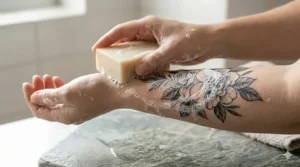
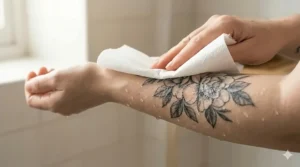
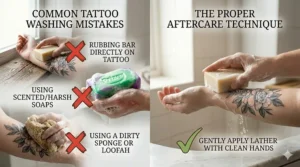
Your artist will tell you when to remove the initial wrap. When you do, you’ll likely see plasma, excess ink, and dried blood on the surface — this is completely normal. Wet your hands (not the tattoo) first, work a small amount of your chosen bar soap into your palms to create a light lather, then apply that lather with your fingertips — never a cloth, never a loofah. Circular motions, gentle pressure, about 20-30 seconds. Rinse with lukewarm water. Pat — never rub — dry with a clean paper towel. Apply a thin layer of unscented tattoo ointment immediately.
Weeks 1-2: The Critical Window
Wash your tattoo 2-3 times daily during the first two weeks. Morning, after any physical activity, and before bed is a solid rhythm. Each wash should follow the same technique: hands-only lather, gentle circular application, thorough rinse, immediate moisturization. Skipping the moisturizer step after washing is one of the most common mistakes and directly causes the thick scabbing that can pull color out when it falls off.
Common Mistakes to Avoid During Healing
Using too much soap. A pea-sized amount of lather is all you need. More soap means more effort to rinse, and vigorous rinsing can irritate.
Washing with water that’s too hot. Hot water opens pores aggressively and can leach ink from fresh punctures. Lukewarm — skin-temperature — is the rule.
Switching soaps mid-heal. If your skin is responding well to one bar, stay with it for the full 4-6 week healing process. Introducing a new formula during healing is unnecessary risk.
Using the same bar for your whole body. Keep a dedicated bar soap for tattoo aftercare separate from your regular body soap to avoid cross-contamination and fragrance transfer.
Real-World Scenarios: Which Bar Soap Is Right for You?
The First-Timer with Normal Skin
You’ve just got your first tattoo — a medium-sized piece on your forearm. Your skin has no particular sensitivities, you’re not prone to reactions, and you want something reliable that won’t require research. Dr. Bronner’s Baby Unscented Bar is your pick. It’s the soap most artists trust, it works on every skin type in the normal range, and it leaves your healing tattoo clean without the anxious second-guessing that comes with more complex formulas.
The Heavily Tattooed Collector on a Budget
You’re on your seventh tattoo, you heal quickly, you know your skin, and you want to spend as little as possible without compromising the work. Dove Sensitive Skin Beauty Bar in a bulk pack is your answer. At around $1-2 per bar and with a formula gentle enough for dermatologist-recommended eczema care, it delivers clinical-grade gentleness at corner-store pricing.
The Reactive Skin Veteran
You’ve had reactions to products marketed as “gentle” before. Something always sneaks in — a masking fragrance, a botanical extract, a preservative your skin hates. For you, Vanicream Cleansing Bar is non-negotiable. Its exclusion list is the most rigorous on this entire list, and that’s exactly what your skin needs when it’s in its most vulnerable healing state.
The Eco-Conscious Minimalist
You don’t want pump bottles, you prefer natural ingredients, and you’d rather your aftercare routine leave as small a footprint as possible. Kirk’s Original Coco Castile Bar is made for you — natural, biodegradable, genuinely effective, and priced so you’ll never hesitate to replace it.
The Dry-Skin Healer
Your skin always feels tight and dry after washing, even with gentle soaps. Scabbing is heavier than average for your tattoos. You need a bar that goes beyond cleaning. CeraVe Hydrating Cleanser Bar, with its ceramide and hyaluronic acid formula, is the only option on this list that actively participates in barrier repair while cleaning. Use it paired with CeraVe moisturizing lotion and your healing experience will likely be smoother than anything you’ve had before.
How to Choose Bar Soap for Tattoo Aftercare: 6 Criteria That Actually Matter
Not all bar soaps are created equal, and the tattoo aftercare market is full of products that sound scientific but deliver little. Here’s how to evaluate any bar soap before trusting it with your fresh ink:
1. Fragrance-Free, Not Just “Unscented” “Unscented” can legally mean fragrance compounds have been added to mask the soap’s natural smell. Look for “fragrance-free” explicitly on the label. This is the most important criterion — fragrance is the leading cause of contact dermatitis in skincare products, according to FDA cosmetics guidelines, and healing tattooed skin is uniquely vulnerable.
2. pH-Balanced or Soap-Free Formula Traditional soap bars (saponified oils) have a naturally alkaline pH of 9-10, which disrupts your skin’s acid mantle. Soap-free syndet bars (Dove, Cetaphil, CeraVe, Vanicream) maintain a pH closer to your skin’s natural 4.5-5.5 range. For the most sensitive healing environments, soap-free is preferable.
3. No Alcohol, No Exfoliants Alcohol dries and potentially damages fresh tattoo ink. Exfoliating agents — walnut scrub, sugar, pumice — are obviously out for the entirety of the healing phase. Check ingredient lists for isopropanol, SD alcohol, and any “micro-bead” or “exfoliant” language.
4. Simple, Short Ingredient Lists The more ingredients, the more potential reactants. During healing, simplicity is your friend. The best bar soaps for tattoo aftercare tend to have under 10-12 core ingredients.
5. Rinses Clean Without Residue Soap residue left on healing skin can clog pores, trap bacteria, and interfere with the oxygen exchange your skin needs for repair. Choose a bar that rinses completely with warm water — lather up, wash for 30 seconds, rinse for 30 seconds.
6. Dermatologist Tested for Sensitive Skin This claim on packaging isn’t regulated as a hard clinical standard, but it does indicate the manufacturer has gone through testing on sensitive skin populations. It’s a useful signal — not a guarantee, but worth noting.
Bar Soap vs. Liquid Soap for Tattoo Aftercare: The Honest Comparison
The internet argues about this. Let’s settle it.
| Factor | Bar Soap | Liquid Soap |
|---|---|---|
| Ingredient simplicity | ✅ Often simpler | ⚠️ Often more additives |
| Hygiene (shared use) | ⚠️ Communal use risk | ✅ No-touch pump |
| Travel convenience | ✅ TSA-friendly, no spillage | ❌ Liquid rules apply |
| Cost per wash | ✅ Generally lower | ⚠️ Variable |
| Availability | ✅ Everywhere | ✅ Everywhere |
| Best options available | ✅ Excellent | ✅ Excellent |
The honest answer: for solo use in your own bathroom, bar soap is equally effective and often more economical. The “bars harbor bacteria” concern is largely overstated for personal-use bars kept dry between washes — research consistently shows that bar soap residue bacteria don’t transfer to skin in clinically meaningful quantities. The real risk is a soggy, waterlogged bar sitting in a shared soap dish — but if you’re using a soap dish with drainage and keeping it dry, this is a non-issue.
The one genuine advantage of liquid soap for tattoo healing is the pump dispenses cleanly without you needing to handle the bar with hands that might not yet be fully clean. If you’re fastidious about cross-contamination, that’s a real point. For everyone else, a good bar soap does the job beautifully.
Both formats contain excellent options. The bar soap for tattoo aftercare category is simply less discussed, which is why this guide exists.
Features That Actually Matter (And Those That Don’t)
Worth Paying For 💰
Ceramide content in your soap (CeraVe) actively helps barrier repair — this is real, functional science, not marketing. True fragrance-free formulation is non-negotiable. Soap-free syndet base matters for reactive and sensitive skin.
Marketing Hype to Ignore 🙄
“Tattoo-specific” branding on generic soap. Some brands slap a tattoo graphic on a standard body bar and charge double. Look at the ingredient list, not the label art. “Hospital grade” claims without specific active ingredient documentation. “Clears toxins from your tattoo.” Your tattoo doesn’t have toxins. It has ink, plasma, and healing skin. Clean it gently.
“Antibacterial” as a premium feature also deserves scrutiny. The FDA’s 2016 ruling on antibacterial soap found that many common antibacterial agents provided no clinical advantage over plain soap and water. For tattoo healing specifically, what you’re trying to do is remove debris and bacteria through mechanical washing — and a gentle, fragrance-free bar with good rinsing action does that as well as any antibacterial formula, usually without the additional irritation risk.
FAQ
❓ Can I use any fragrance-free bar soap on a new tattoo?
❓ How many times a day should I wash a new tattoo with bar soap?
❓ Is bar soap better than liquid soap for tattoo aftercare?
❓ Can I use Dr. Bronner's bar soap on a new tattoo?
❓ What ingredients should I avoid in a bar soap for tattoo aftercare?
Conclusion: The Right Bar Soap Makes a Real Difference
Here’s the thing about tattoo aftercare that nobody talks about enough: the decisions you make in the first two weeks determine what that piece looks like for the next twenty years. Soft heals mean sharp lines. Good moisture management means vibrant color retention. And the right soap — gentle, clean, pH-appropriate — is the foundation of both.
You don’t need to spend a fortune. You don’t need a formula with twelve active ingredients and a four-paragraph promise. You need something fragrance-free, gentle on your skin’s healing barrier, and consistent. Dr. Bronner’s Baby Unscented Bar for the natural purist. Dove Sensitive Skin Beauty Bar for the budget buyer. Vanicream Cleansing Bar for reactive skin. CeraVe Hydrating Cleanser Bar for dry skin that needs barrier support. Any of them, used correctly 2-3 times daily with proper technique, will serve your ink beautifully.
Pick one. Stick with it. Moisturize immediately after every wash. Keep your hands clean before touching the tattoo. And let time do the rest.
✨ Don’t Miss These Deals!
🔍 Ready to protect your fresh ink? Click on any of the highlighted products above to check current availability and pricing on Amazon. Your tattoo deserves the cleanest, gentlest start possible!
Recommended for You
- 7 Best Bar Soap for Hard Water: Top Picks That Actually Lather (2026)
- 7 Best Organic Bar Soap Gift Sets of 2026
- Best Natural Bar Soap for Men: 7 Powerful Picks That Actually Work (2026)
Disclaimer: This article contains affiliate links. As an Amazon Associate, I earn from qualifying purchases. If you purchase products through these links, we may earn a small commission at no additional cost to you.
✨ Found this helpful? Share it with your friends! 💬🤗
